
Are You Claiming the Export Benefits Available to Your Business?
Indian exporters face several cost challenges when competing in international markets. Import duties on raw materials, manufacturing expenses, customs procedures, logistics costs and regulatory requirements can directly affect export profitability. However, many businesses do not fully understand the government schemes available to reduce eligible costs and support international trade.
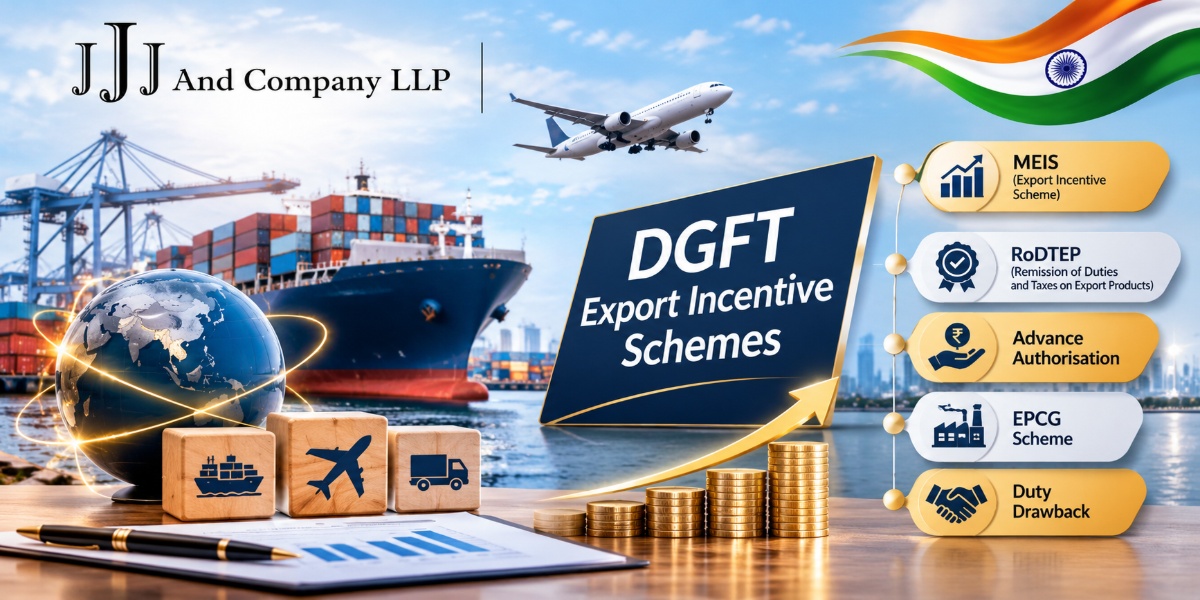
The Directorate General of Foreign Trade (DGFT), under the Ministry of Commerce and Industry, administers important export promotion schemes under India’s Foreign Trade Policy. These include the Remission of Duties and Taxes on Exported Products (RoDTEP), Advance Authorisation, Export Promotion Capital Goods (EPCG) and Duty Free Import Authorisation (DFIA). The Customs Department also administers the Duty Drawback mechanism.
Each scheme serves a different business requirement. RoDTEP provides remission of eligible embedded duties and taxes, Advance Authorisation supports duty-free imports of eligible production inputs, EPCG facilitates capital equipment imports against export obligations, and Duty Drawback provides a refund of eligible customs duties.
For manufacturers, merchant exporters, MSMEs and established export houses, selecting the correct scheme can make a meaningful difference to the cost of international business.
JJJ & Company LLP provides professional assistance with DGFT registration, export incentive schemes, authorisation applications and export-import compliance.
1. What Are DGFT Export Incentive Schemes in India?
DGFT export incentive schemes are government-supported mechanisms designed to improve the competitiveness of Indian exporters. They provide specified duty-related benefits, remission or support for eligible export activities.
Businesses involved in manufacturing, importing raw materials, exporting finished products or investing in production machinery may be eligible for different benefits, depending on the applicable scheme conditions.
The major schemes include:
| Scheme | Main benefit | Suitable for |
| RoDTEP | Remission through electronic duty credit scrips | Eligible product exporters |
| Advance Authorisation | Duty-free import of eligible inputs | Manufacturers and eligible exporters |
| EPCG | Import of capital goods at zero customs duty under the scheme | Manufacturers and service providers |
| Duty Drawback | Refund of eligible customs duties | Exporters of eligible products |
| DFIA | Duty-free import of eligible inputs on a post-export basis | Eligible exporters meeting scheme conditions |
These schemes are not interchangeable. An exporter should assess the product classification, manufacturing process, import requirements and export obligations before applying.
2. RoDTEP Scheme: Remission of Duties and Taxes on Exported Products
The RoDTEP Scheme is one of the important export incentive schemes in India. Its purpose is to remit eligible duties, taxes and levies that remain embedded in exported products and are not otherwise refunded or credited.
Certain costs may arise at different stages of the production and supply chain. If these eligible costs remain unrefunded, they can increase the effective cost of Indian exports.
How does the RoDTEP Scheme work?
Eligible exporters can claim benefits at the notified rates and value caps applicable to their export products. The benefit is generally issued through an electronic duty credit scrip, subject to the scheme’s conditions and customs procedures.
The applicable benefit is determined by factors such as:
- Product classification under the ITC-HS code.
- Applicable RoDTEP rate.
- Notified value cap, where applicable.
- Eligibility of the exporter and export transaction.
- Correct declaration and claim processing through customs.
Important update: As of November 2026, the RoDTEP Scheme has been extended until 31 December 2026 for eligible exports from Domestic Tariff Area (DTA) units, Advance Authorisation holders, Special Economic Zone (SEZ) units and Export Oriented Units (EOUs). Exporters should check the latest DGFT notification and applicable Appendix 4R or 4RE rates before claiming benefits.
Who should check RoDTEP eligibility?
- Manufacturers exporting finished products.
- Merchant exporters.
- MSME exporters.
- Eligible SEZ and EOU exporters.
- Advance Authorisation holders whose exports qualify under the scheme.
3. Advance Authorisation Scheme: Duty-Free Import of Raw Materials
The Advance Authorisation Scheme allows eligible exporters to import specified inputs without payment of basic customs duty, subject to the scheme’s conditions and export obligation.
It is particularly useful for manufacturers who import raw materials, components or consumables required to manufacture goods for export.
How does Advance Authorisation work?
An eligible exporter obtains an authorisation to import specified inputs required for manufacturing export products. The imported inputs must satisfy the applicable input-output norms and other conditions.
The scheme generally requires:
- Identification of the export product.
- Determination of eligible imported inputs.
- Compliance with applicable Standard Input Output Norms (SION), where available, or permitted alternative norms.
- Application for Advance Authorisation through DGFT.
- Import of eligible inputs under the authorisation.
- Completion of the prescribed export obligation.
- Submission of relevant documents for redemption or closure.
What is the benefit of Advance Authorisation?
The primary benefit is the permitted duty-free import of eligible inputs used in the production of export goods. This can help reduce manufacturing costs and improve export pricing.
However, the benefit comes with responsibilities. Exporters must track imported quantities, consumption, production records, shipping bills and export obligation deadlines.
4. EPCG Scheme: Import Capital Goods at Zero Customs Duty
The Export Promotion Capital Goods (EPCG) Scheme supports businesses that want to modernise production facilities, improve manufacturing capacity or invest in equipment for export production.
Under the scheme, eligible capital goods can be imported at zero customs duty, subject to the applicable conditions and fulfilment of export obligations.
Who can apply for an EPCG licence?
Depending on eligibility conditions, the scheme may be relevant to:
- Manufacturer exporters.
- Merchant exporters tied to supporting manufacturers.
- Service providers.
- Businesses investing in eligible production equipment.
What capital goods can be covered?
Eligible capital goods may include machinery, production equipment and specified equipment used for pre-production, production and post-production activities.
The exact eligibility depends on the applicable Foreign Trade Policy provisions and exclusions.
What is the EPCG export obligation?
Under the standard EPCG framework, the specific export obligation is generally equivalent to six times the duties, taxes and cess saved on the capital goods imported, to be fulfilled within six years from the date of authorisation, subject to applicable policy provisions and exceptions.
An average export obligation may also apply, depending on the exporter’s previous performance and the relevant rules.
Failure to fulfil the required export obligation can result in duty recovery, interest and other consequences.
5. Duty Drawback Scheme: Refund of Customs Duty on Exported Products
The Duty Drawback Scheme provides a refund of eligible customs duties on imported inputs used in the manufacture of exported products, subject to applicable conditions.
It is an important export benefit for businesses that use imported materials or components in their production process.
How does Duty Drawback work?
Duty Drawback may be claimed under the applicable All Industry Rate (AIR) or Brand Rate mechanism, depending on the product and eligibility.
- All Industry Rate: A notified drawback rate applicable to eligible goods under the relevant tariff classification.
- Brand Rate: A rate determined for eligible cases where the prescribed conditions for a specific drawback calculation are met.
The claim is generally processed through customs based on shipping bill declarations and the applicable procedures.
What should exporters check?
- Correct HS code and product classification.
- Applicable drawback rate and value cap.
- Shipping bill declaration.
- Eligibility of the exported product.
- Supporting import and manufacturing records, where required.
- Whether any other duty exemption or remission has already been claimed.
Exporters should not assume that every duty paid on every input is automatically refundable. The claim must comply with the Customs Act, applicable Drawback Rules and relevant notifications.
6. RoDTEP vs Advance Authorisation vs EPCG vs Duty Drawback
Choosing the right export incentive scheme requires understanding what the business actually needs.
| Comparison | RoDTEP | Advance Authorisation | EPCG | Duty Drawback |
| Main purpose | Remission of eligible embedded taxes | Duty-free eligible inputs | Duty-free capital goods | Refund of eligible customs duties |
| Main focus | Exported product | Raw materials and inputs | Machinery and equipment | Duties on eligible inputs |
| Export obligation | No separate scheme-specific EO like AA/EPCG | Yes | Yes | No comparable AA/EPCG-style EO |
| Main compliance | Correct export declaration and claim | Input use and export obligation | Capital goods use and export obligation | Correct shipping bill and drawback eligibility |
A manufacturer importing raw materials for export production may consider Advance Authorisation. A business investing in new machinery may evaluate EPCG. An eligible exporter may examine RoDTEP and Duty Drawback depending on the product, transaction and applicable restrictions.
The schemes should be evaluated together rather than assuming that every benefit can be claimed simultaneously.
7. DGFT Registration and Documents Required for Export Incentives
Before applying for DGFT authorisations, exporters should ensure that their basic import-export registrations and records are in order.
Common requirements may include:
- Import Export Code (IEC).
- Active IEC profile and applicable annual update.
- Digital Signature Certificate or permitted e-sign facility.
- GST registration details, where applicable.
- Bank account and AD code-related export records, as required.
- Registration-cum-Membership Certificate (RCMC), where required.
- Product ITC-HS classification.
- Purchase invoices and import documents.
- Shipping bills and export invoices.
- Bills of Entry and manufacturing records, where relevant.
- Export obligation and authorisation records.
The exact documents vary by scheme and application type.
8. Export Obligation Fulfilment, EODC and DGFT Licence Closure
Obtaining an export authorisation is only one part of the process. Exporters using Advance Authorisation or EPCG must also monitor and fulfil the applicable export obligations.
An Export Obligation Discharge Certificate (EODC) is an important document in the closure process after the relevant conditions have been fulfilled.
Common compliance activities include:
- Tracking the export obligation period.
- Maintaining shipping bills and export invoices.
- Reconciling imports against authorised quantities.
- Monitoring export performance.
- Applying for extension or regularisation where legally permitted.
- Submitting the required evidence for redemption.
- Obtaining EODC and completing authorisation closure.
DGFT and ICEGATE integration has also simplified verification of specified voluntary duty payments for EODC applications under Advance Authorisation and EPCG, reducing the need for physical challan submission in the relevant process.
Missing deadlines or failing to maintain records can create difficulties during authorisation redemption.
Related search keywords: EODC application, EODC certificate, EPCG licence closure, Advance Authorisation redemption, export obligation fulfilment, DGFT licence closure, export obligation extension, DGFT regularisation.
9. Additional Export Benefits: GST Refund, LUT and RoSCTL
DGFT export incentive schemes are not the only mechanisms relevant to exporters.
GST refund on exports
Exports are treated as zero-rated supplies under GST. Eligible exporters may generally export under a Letter of Undertaking (LUT) without payment of IGST and claim a refund of eligible unutilised input tax credit, or follow the permitted route of exporting on payment of IGST and claiming a refund, subject to applicable conditions.
RoSCTL Scheme
The Rebate of State and Central Taxes and Levies (RoSCTL) Scheme is relevant to eligible exports of apparel and made-ups. It addresses specified embedded state and central taxes and levies.
Exporters should check the latest scheme notifications, product eligibility and claim procedures.
Why should businesses review these benefits together?
A complete export cost review should consider DGFT authorisations, customs benefits, GST refunds and other applicable export support measures. Each benefit has separate conditions, and overlapping claims may be restricted.
10. How JJJ & Company LLP Helps with DGFT Export Incentive Compliance
Understanding an export incentive is different from successfully applying for and managing it. Businesses must identify the right scheme, check eligibility, prepare supporting records, meet deadlines and maintain compliance throughout the export cycle.
JJJ & Company LLP provides professional support for businesses seeking assistance with DGFT and export-import compliance.
Our services include:
- IEC registration, modification and compliance assistance.
- DGFT authorisation application support.
- RoDTEP scheme guidance and claim-related assistance.
- Advance Authorisation application and redemption support.
- EPCG licence application and export obligation tracking.
- Duty Drawback eligibility and documentation review.
- EODC application and authorisation closure support.
- RCMC and export documentation guidance.
- GST LUT and export refund compliance assistance.
Planning to claim export incentives or close an existing DGFT authorisation?
Connect with JJJ & Company LLP for professional guidance on DGFT schemes, export benefits and regulatory compliance.
Frequently Asked Questions About DGFT Export Incentive Schemes
1. What are the main DGFT export incentive schemes in India?
Important schemes include RoDTEP, Advance Authorisation, EPCG and DFIA. Duty Drawback and GST export refunds are also relevant to eligible exporters, although they operate under separate legal and administrative frameworks.
2. What is the RoDTEP Scheme and who can claim it?
RoDTEP provides remission of eligible embedded duties and taxes on notified export products. Eligibility depends on the product, exporter category, applicable rates and scheme conditions.
3. What is the difference between Advance Authorisation and EPCG?
Advance Authorisation supports duty-free imports of eligible inputs used in export production. EPCG supports eligible capital goods imports at zero customs duty against prescribed export obligations.
4. What is the EPCG export obligation period?
Under the standard EPCG framework, the specific export obligation is generally six times the duty saved, to be fulfilled within six years from the authorisation date, subject to applicable policy conditions and exceptions.
5. How can exporters apply for Advance Authorisation?
Eligible exporters can apply through the DGFT online portal by submitting the prescribed application, product details, input-output information and supporting documents. The applicable norms and procedures must be followed.
6. What is an EODC certificate?
An Export Obligation Discharge Certificate confirms the discharge of the relevant export obligation under an authorisation, subject to verification and applicable DGFT procedures.
7. Can an exporter claim RoDTEP and Duty Drawback together?
The availability of both benefits depends on the applicable scheme rules, product eligibility and restrictions. Exporters should verify the current notifications and shipping bill declarations before claiming both.
8. Is IEC mandatory for DGFT export incentive schemes?
A valid Import Export Code is generally a fundamental requirement for exporters seeking DGFT authorisations and conducting export-import transactions, subject to applicable exemptions.
9. What happens if an exporter fails to fulfil the export obligation?
Failure to meet the obligation may lead to regularisation requirements, recovery of duty saved, applicable interest and other consequences under the relevant scheme provisions.
10. Can a Chartered Accountant help with DGFT export incentive schemes?
Yes. A Chartered Accountant can assist with eligibility reviews, tax and duty impact analysis, documentation, export obligation tracking, compliance planning and coordination of relevant applications.