


Starting a Business in India? Choose the Right Business Structure
Choosing between a Limited Liability Partnership (LLP) and a Private Limited Company is one of the most important decisions when starting a business. The right structure can influence taxation, compliance costs, fundraising opportunities, ownership flexibility, and future expansion.
JJJ & Company LLP helps entrepreneurs and businesses evaluate company incorporation options, tax implications, and regulatory requirements.
Get Expert Business Structuring Advice from JJJ & Company LLP.
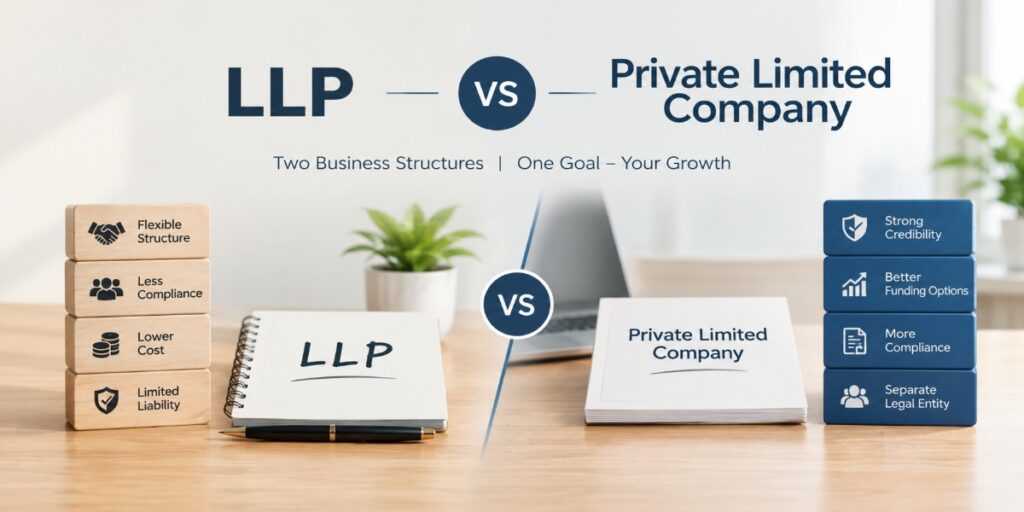
When launching a startup in India, founders often compare an LLP Vs Private Limited Company. Both structures offer a separate legal identity and limited liability, but they differ significantly in ownership, compliance, taxation, and investment opportunities.
An LLP is generally suitable for consultants, professional service providers, agencies, and businesses that want flexible management with relatively fewer compliance requirements. A Private Limited Company is often preferred by startups planning to raise venture capital, issue employee stock options, attract investors, or scale rapidly.
However, there is no single structure that is best for every business. The right choice depends on your business model, long-term goals, expected profitability, and funding requirements.
This guide compares LLP vs Private Limited Company in India to help entrepreneurs make an informed decision.
What Is a Limited Liability Partnership (LLP)?
A Limited Liability Partnership is a business structure governed by the Limited Liability Partnership Act, 2008. It combines the flexibility of a traditional partnership with the benefit of limited liability.
An LLP is a separate legal entity from its partners. Generally, a partner’s liability is limited to their agreed contribution, subject to applicable legal exceptions, including liability arising from fraud.
Key Features of an LLP
- Requires at least two partners.
- Provides a separate legal identity.
- Offers flexible internal management through an LLP agreement.
- Allows partners to establish agreed profit-sharing arrangements.
- Generally involves fewer recurring corporate governance formalities than a company.
- Does not issue shares like a Private Limited Company.
An LLP can be a practical choice for consulting businesses, marketing agencies, professional service firms, and startups that do not expect to raise equity investment.
What Is a Private Limited Company?
A Private Limited Company is incorporated under the Companies Act, 2013, and is commonly used by startups seeking structured ownership and scalable operations.
The company has a separate legal identity, and its ownership is represented by shares. Shareholders generally have limited liability, subject to applicable legal exceptions.
Key Features of a Private Limited Company
- Requires at least two shareholders and two directors, subject to applicable statutory requirements.
- Provides a separate legal identity.
- Allows ownership to be represented through shares.
- Can issue eligible equity or preference share instruments in accordance with applicable law.
- Can establish employee stock option plans, subject to legal requirements.
- Is generally better suited to venture capital and institutional equity fundraising.
- Has more extensive annual compliance and corporate governance obligations.
For startups planning substantial growth, investor participation, or employee equity incentives, a Private Limited Company often provides greater flexibility.
LLP vs Private Limited Company: Key Differences
| Comparison factor | LLP | Private Limited Company |
| Governing legislation | LLP Act, 2008 | Companies Act, 2013 |
| Minimum owners | 2 partners | 2 shareholders |
| Separate legal entity | Yes | Yes |
| Limited liability | Generally limited to agreed contribution | Generally limited to shareholding obligations |
| Ownership structure | Partners and LLP agreement | Shareholders and shares |
| Equity fundraising | Cannot issue company shares | Can issue shares and eligible investment instruments |
| Venture capital suitability | Generally less suitable | Generally preferred |
| Employee stock options | No conventional company ESOPs | Available subject to applicable rules |
| Management | Flexible partner-led structure | Directors and shareholders |
| Statutory audit | Subject to prescribed thresholds and rules | Generally mandatory every financial year |
| Annual compliance | Generally simpler | Generally more extensive |
| Tax treatment | Generally taxed at 30%, plus applicable surcharge and cess | Depends on applicable regime and eligibility |
| Profit distribution | Partner profit share generally not taxed again as dividend income | Dividends are generally taxable in shareholders’ hands |
| Typical use | Consulting, agencies, professional services | Scalable startups, investor-backed businesses |
The actual compliance and tax position depends on the entity’s circumstances and the laws applicable to the relevant financial year.
1. LLP vs Private Limited Company: Which Has Lower Compliance Costs?
Compliance costs are an important consideration for startups with limited budgets.
An LLP generally has fewer corporate governance requirements. Its principal annual MCA filings include Form 11, the annual return, and Form 8, the statement of account and solvency. Income tax return filing and other applicable obligations must also be completed.
An LLP’s accounts are subject to statutory audit when the prescribed turnover or contribution thresholds are crossed, subject to applicable rules.
A Private Limited Company generally requires a statutory audit regardless of turnover, annual financial statement and annual return filings, director-related compliance, and prescribed board and shareholder meetings.
These additional requirements can increase accounting, audit, and professional fees.
Which is better? An LLP may be more economical for a small service business. A Private Limited Company may justify the additional compliance cost when the business needs investment, formal corporate governance, or a scalable ownership structure.
2. Taxation: Is an LLP More Tax-Efficient?
Taxation is another major factor when comparing an LLP with a Private Limited Company in India.
An LLP is generally taxed at a flat rate of 30% on its taxable income, with applicable surcharge and health and education cess. Its partners’ share of profits is generally exempt from tax in their hands under the applicable provisions.
A Private Limited Company may qualify for concessional corporate taxation under Section 115BAA of the Income-tax Act, 1961, at a base rate of 22%, subject to specified conditions and restrictions. Other corporate tax provisions may apply depending on the company’s circumstances.
However, shareholders may also incur tax when profits are distributed as dividends. Consequently, comparing only the headline income tax rates does not establish which structure offers the lowest overall tax burden.
Before deciding, founders should evaluate:
- Expected annual profits.
- Applicable tax regime and eligibility.
- Availability of deductions and incentives.
- Whether profits will be retained or distributed.
- Tax treatment of payments to partners or shareholders.
- Eligibility for relevant startup tax benefits.
A professional tax comparison can help determine which structure is more appropriate for the business.
3. Fundraising and Investor Opportunities
If your startup plans to raise capital from angel investors, venture capital funds, or institutional investors, a Private Limited Company is generally the preferred structure.
It can issue shares and eligible securities, subject to applicable law, allowing investors to acquire an ownership interest in the business.
An LLP cannot issue shares in the same way. An incoming investor generally needs to participate through the LLP’s partnership structure and applicable agreement, which may not suit conventional venture capital investment arrangements.
A Private Limited Company can also offer employee stock options, helping eligible startups attract and retain employees.
Choose a Private Limited Company if your business expects to raise equity funding, create an employee equity plan, or pursue institutional investment.
Get Professional Guidance Before Registering Your Startup
Choosing the wrong structure can create additional work if your business later needs restructuring, ownership changes, or investment.
JJJ & Company LLP can help founders evaluate LLP and Private Limited Company registration options, tax considerations, compliance requirements, and long-term business objectives.
Whether you are launching a consulting firm, a digital agency, a technology startup, or a growing enterprise, obtain professional advice before finalising your incorporation structure.
Contact JJJ & Company LLP to discuss the most suitable business structure for your startup.
4. Startup India Recognition and Tax Benefits
Eligible businesses may apply for recognition under the Startup India initiative, subject to the applicable eligibility criteria.
Both Private Limited Companies and LLPs can qualify for DPIIT startup recognition if they meet the relevant requirements.
However, startup recognition does not automatically provide every tax benefit. Eligibility for a particular deduction, exemption, or incentive must be assessed separately.
For example, eligibility for the deduction under Section 80-IAC is subject to specific statutory conditions and the applicable approval process. Founders should verify the current rules before selecting an entity structure based on expected tax benefits.
A business should evaluate its innovation objectives, turnover, incorporation date, ownership, and intended activities when considering startup recognition.
5. Which Structure Is Better for Different Types of Startups?
The most appropriate structure depends on your commercial objectives.
Choose an LLP if:
- You are starting a consulting or professional services business.
- You operate a small marketing or creative agency.
- You want flexible partner-led management.
- You do not expect to raise conventional equity funding.
- You prefer a relatively simpler compliance structure.
Choose a Private Limited Company if:
- You plan to raise angel or venture capital investment.
- You want to issue shares to co-founders or investors.
- You intend to implement an employee stock option plan.
- You plan to expand rapidly into multiple markets.
- You want a structure designed for institutional fundraising and ownership changes.
These are general guidelines. The final decision should account for your actual business model, tax position, regulatory requirements, and future plans.
6. Can You Convert an LLP into a Private Limited Company Later?
Businesses sometimes begin as LLPs and later consider restructuring when their funding or growth requirements change.
A conversion or restructuring may be possible through an applicable statutory route, but it is not always a simple administrative change. The available procedure, eligibility conditions, tax consequences, contracts, licences, assets, liabilities, and ownership arrangements must be evaluated.
Restructuring can also involve legal documentation, professional fees, and regulatory filings.
If you anticipate seeking institutional investment within the next few years, evaluating a Private Limited Company at the beginning may reduce the need for a later structural change.
Frequently Asked Questions
1. Is an LLP better than a Private Limited Company for startups?
An LLP may suit service businesses and startups that prioritise flexible management and simpler compliance. A Private Limited Company is generally more suitable for startups seeking equity funding, investor participation, and employee stock options.
2. Which structure has lower compliance costs in India?
An LLP generally has fewer corporate governance and annual compliance requirements. A Private Limited Company requires a statutory audit and additional corporate filings. Actual costs depend on business complexity and professional fees.
3. Can an LLP raise funding from investors?
An LLP can admit new partners and arrange financing subject to applicable law and its agreement. However, it cannot issue company shares, making it less suitable for conventional venture capital and equity investment structures.
4. Which structure pays less tax: LLP or Private Limited Company?
There is no universal answer. LLPs are generally taxed at 30%, plus applicable surcharge and cess. Eligible companies may opt for concessional corporate taxation, but dividend taxation and other factors affect the overall outcome. A personalised tax comparison is advisable.
5. Can an LLP qualify for Startup India recognition?
Yes. An eligible LLP can apply for DPIIT startup recognition, subject to the applicable conditions. Specific tax benefits require separate eligibility checks.
6. Can I convert an LLP into a Private Limited Company?
Restructuring may be possible under an applicable legal procedure, subject to eligibility, documentation, regulatory approvals where required, and tax considerations. Obtain professional advice before proceeding.
Conclusion
The decision between an LLP and a Private Limited Company should be based on your startup’s long-term objectives rather than incorporation cost alone.
An LLP can be a suitable choice for founders who value flexible management, profit-sharing arrangements, and relatively simpler compliance. A Private Limited Company is generally better suited to businesses planning equity fundraising, employee stock options, and rapid expansion.
Before registering, compare taxation, compliance costs, ownership arrangements, funding plans, and eligibility for applicable startup benefits.
JJJ & Company LLP can help you evaluate your incorporation options and make an informed decision based on your business goals. Contact JJJ & Company LLP for professional company incorporation and tax advisory support.