

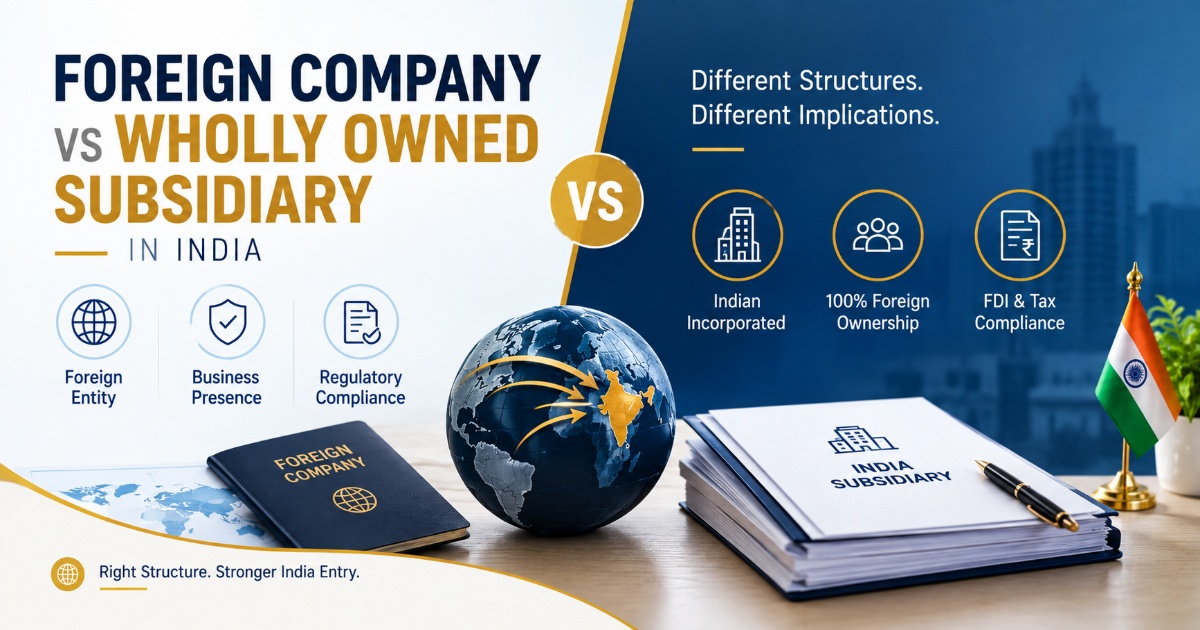
Planning to expand your overseas business into India?
Choosing between establishing a Foreign Company presence in India and incorporating a Wholly Owned Subsidiary (WOS) is an important structural decision. The right structure can affect your operations, liability, taxation, funding, regulatory compliance and long-term expansion strategy.
Expert Support for Foreign Business Setup in India
JJJ and Company LLP assists foreign businesses with India entry, company incorporation, FEMA/FDI compliance, corporate structuring, taxation and ongoing regulatory requirements.
Get professional guidance before selecting your India entry structure.
Foreign Company vs Wholly Owned Subsidiary: What Is the Difference?
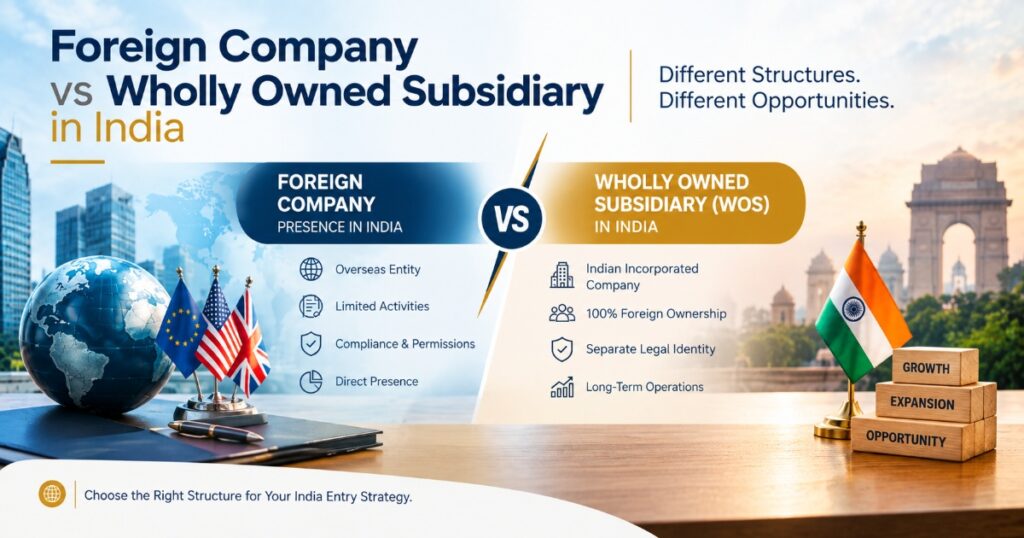
A foreign company is a company or body corporate incorporated outside India that falls within the definition under the Companies Act, 2013, including where it has a place of business in India or conducts business activity in India in the manner covered by the Act.
A Wholly Owned Subsidiary (WOS), in contrast, is an Indian company incorporated under Indian company law whose shares are held entirely by the foreign parent, subject to applicable foreign investment rules and sectoral conditions.
In simple terms:
- A foreign company structure allows an overseas entity to establish an eligible business presence in India.
- A WOS creates a separate Indian incorporated company controlled by the foreign parent.
- The compliance, liability, accounting and operational framework can therefore be different.
The choice should be based on the proposed activities, investment structure, sector-specific rules, liability considerations and long-term business objectives.
What Is a Foreign Company in India?
Under Section 2(42) of the Companies Act, 2013, a foreign company generally means a company or body corporate incorporated outside India that has a place of business in India, whether directly or through an agent, including through electronic mode, and conducts business activity in India in the manner specified under the Act.
Depending on the business model, an overseas company may consider structures such as a:
- Branch Office
- Liaison Office
- Project Office
- Other permitted presence covered by applicable regulations
The permitted activities and approval/compliance requirements differ according to the type of presence.
A foreign company entering India therefore needs to examine both Companies Act requirements and applicable FEMA/RBI rules, along with tax and sector-specific regulations.
What Is a Wholly Owned Subsidiary in India?
A Wholly Owned Subsidiary is an Indian incorporated company that is fully owned by its foreign parent, subject to applicable FDI rules.
The Indian subsidiary has its own legal identity separate from its overseas parent. It can conduct business in India within the scope permitted by its constitutional documents, applicable laws and sectoral regulations.
Foreign investment into an Indian company may fall under the Automatic Route or Government Route, depending on the sector and applicable conditions. The applicable sectoral cap, entry route and other conditions must be checked before investment is made.
A WOS can therefore be considered where a foreign group wants an established Indian corporate vehicle for carrying out ongoing business operations.
Foreign Company vs WOS: Key Differences
| Factor | Foreign Company Presence | Wholly Owned Subsidiary |
| Legal structure | Foreign incorporated entity operating in India | Separate Indian incorporated company |
| Parent relationship | Direct presence of overseas company | Indian subsidiary owned by foreign parent |
| Liability | Depending on structure, exposure can connect to foreign entity | Indian company has separate legal personality |
| Business activities | Depend on the type of foreign presence and applicable permissions | Generally operates through its Indian corporate structure, subject to applicable laws |
| Investment structure | Funding can depend on the chosen foreign presence | Foreign parent invests in Indian company equity |
| Compliance | Companies Act, FEMA/RBI and applicable tax/regulatory requirements | Companies Act, FEMA/FDI, tax and other applicable requirements |
| Long-term India operations | Depends on selected structure | Often structured as an ongoing Indian operating company |
| Governance | Depends on the foreign presence | Indian company has its own corporate governance requirements |
This comparison is general. The exact requirements depend on the proposed sector, ownership, activities and investment structure.
Which Structure Is Relevant for a Foreign Business?
There is no single structure applicable to every foreign investor.
A business planning to conduct a limited activity in India may have different requirements from a foreign group planning to establish manufacturing, technology, trading, consulting or other substantial operations.
Before selecting a structure, consider:
1. Nature of Business Activity
The proposed activity should be checked against India’s applicable foreign investment policy and sector-specific regulations.
2. FDI Entry Route
Foreign investment in an Indian company can be under the Automatic Route or Government Route, depending on the applicable sector and conditions.
3. Sectoral Cap
The maximum permitted foreign investment can vary by sector. Additional statutory, licensing, security or other conditions may also apply.
4. Business Objectives
A foreign business intending to establish a long-term Indian operating company may need a different structure from one seeking only a limited or representative presence.
5. Tax Considerations
The structure can have different Indian tax and withholding implications. Cross-border payments, transfer pricing, permanent establishment considerations and transactions with the overseas parent should be reviewed.
6. Compliance Requirements
Both foreign company structures and Indian subsidiaries can involve ongoing corporate, tax, FEMA and regulatory compliance. These obligations should be assessed before incorporation or commencement of operations.
WOS Incorporation in India: General Process
Where a WOS structure is appropriate, the incorporation process generally involves several stages.
Step 1: Determine the Proposed Structure
Identify the business activity, ownership pattern, proposed capital and appropriate Indian company structure.
Step 2: Check FDI Eligibility
Review the relevant sectoral cap, entry route and applicable conditions before bringing foreign investment into India. RBI guidance on foreign investment reporting also requires the applicable entry route and sectoral/statutory ceiling to be considered.
Step 3: Prepare Foreign Parent Documents
Corporate documents of the foreign parent may need appropriate certification, notarisation, apostille/consularisation or other formalities depending on the jurisdiction and applicable Indian requirements.
Step 4: Incorporate the Indian Company
The incorporation process is completed through the applicable Ministry of Corporate Affairs procedures.
Step 5: Receive Foreign Investment
The investment should be structured and received in accordance with the applicable FEMA/FDI framework.
Step 6: Complete Post-Incorporation Compliance
The new company may have ongoing requirements relating to statutory registers, accounting, tax, annual filings, foreign investment reporting and other regulatory matters.
Compliance After Setting Up a WOS
Incorporation is only the beginning.
A foreign-owned Indian subsidiary may need to manage:
- ROC and Companies Act compliance
- Income-tax compliance
- GST compliance, where applicable
- FEMA/FDI reporting
- Transfer pricing documentation for eligible international transactions
- Related-party transaction compliance
- Accounting and statutory audit
- Board and shareholder documentation
- Foreign investment reporting
- Employment and other operational registrations, where applicable
For example, RBI’s reporting framework includes foreign investment reporting requirements and requires relevant details such as entry route and applicable sectoral/statutory limits to be considered.
This makes post-incorporation compliance just as important as the initial company formation.
Tax & Transfer Pricing Considerations
Foreign groups establishing an Indian subsidiary should consider the tax relationship between the parent and Indian company from the beginning.
Transactions may include:
- Management fees
- Technical service fees
- Royalty
- Software or technology payments
- Loans and interest
- Purchase or sale of goods
- Shared services
- Reimbursements
Where transactions with associated enterprises fall within India’s transfer pricing provisions, appropriate analysis, documentation and reporting may be required.
The structure should therefore be reviewed from a combined corporate, FEMA, direct tax and transfer pricing perspective rather than treating incorporation as an isolated compliance exercise.
Foreign Company vs WOS: Questions Businesses Should Ask
Before establishing an Indian presence, a foreign investor should ask:
What activities will the Indian operation perform?
The answer can influence the appropriate structure and regulatory requirements.
Will the Indian operation require an independent corporate vehicle?
If yes, a subsidiary structure may need to be evaluated.
What is the applicable FDI route?
The sector, activity, ownership and applicable conditions need to be checked.
What will be the relationship between the Indian entity and foreign parent?
This is important for funding, services, intellectual property, imports, exports and intercompany transactions.
What are the ongoing compliance obligations?
The investor should understand the annual corporate, tax, FEMA and transfer pricing requirements before beginning operations.
Why Professional Structuring Matters
Foreign investment into India involves multiple regulatory layers. A structure that appears straightforward from a corporate perspective can create additional FEMA, tax or transfer pricing considerations.
A proper review can help businesses assess:
- India entry structure
- FDI eligibility
- Sectoral restrictions
- Incorporation requirements
- Foreign parent documentation
- FEMA compliance
- Tax implications
- Transfer pricing exposure
- Ongoing corporate compliance
Plan Your India Entry with JJJ and Company LLP
JJJ and Company LLP provides professional support for foreign companies entering the Indian market, including foreign company registration, wholly owned subsidiary incorporation, FEMA/FDI compliance, taxation, transfer pricing and ongoing corporate compliance.
Whether you are establishing an Indian subsidiary or evaluating another permitted India-entry structure, professional review can help align the setup with the applicable regulatory framework.
Speak with JJJ and Company LLP for India market-entry and foreign investment compliance support.
Conclusion
The decision between a Foreign Company presence and a Wholly Owned Subsidiary in India depends on the nature of the proposed operations, investment structure, sectoral requirements, regulatory permissions, taxation and long-term business plans.
A foreign company structure and an Indian WOS are not simply two interchangeable registration options. They can involve different legal, compliance, tax and operational considerations.
Before committing capital or commencing operations, foreign investors should review the proposed structure under the Companies Act, FEMA/FDI framework, tax laws and sector-specific regulations.
JJJ and Company LLP can assist businesses in evaluating their India entry structure and coordinating the associated incorporation, FEMA, taxation, transfer pricing and compliance requirements.
FAQs
1. What is the difference between a foreign company and a WOS in India?
A foreign company is incorporated outside India and may establish a permitted business presence in India. A WOS is an Indian incorporated company wholly owned by its foreign parent, subject to applicable FDI rules.
2. Can a foreign company establish a wholly owned subsidiary in India?
A foreign company can establish an Indian subsidiary subject to the applicable Companies Act, FEMA/FDI rules, sectoral conditions and other regulatory requirements.
3. Is a WOS a separate legal entity from its foreign parent?
Yes. An Indian subsidiary is incorporated as an Indian company and has a separate legal identity from its foreign parent.
4. Is FDI approval required for every WOS?
Not necessarily. The applicable FDI entry route depends on the sector, activity, foreign investment level and other conditions. Some activities may be eligible for the Automatic Route, while others may require Government approval.
5. What documents are required from a foreign parent for WOS incorporation?
Documents can include corporate incorporation documents, constitutional documents, board resolutions, identification/address documents and other information required for incorporation and foreign investment compliance. Certification and authentication requirements can vary based on the jurisdiction.
6. Does a WOS need to comply with Indian tax laws?
Yes. An Indian subsidiary is generally subject to applicable Indian tax and corporate compliance requirements, depending on its activities and circumstances.
7. Does transfer pricing apply to transactions between a WOS and its foreign parent?
Where the transactions fall within the applicable international transaction provisions, Indian transfer pricing requirements may apply.
JJJ and Company LLP
Foreign Company Registration | Wholly Owned Subsidiary | FEMA & FDI Compliance | India Market Entry | Taxation | Transfer Pricing