
What Are the Latest GST Updates in 2026?
The Goods and Services Tax (GST) framework in India continues to evolve as the government works towards simpler tax administration, better compliance and reduced disputes between taxpayers and authorities. The 57th GST Council meeting, held on 8 October 2026, recommended several important changes relating to GST registration, return filing, refunds, input tax credit (ITC), penalties, prosecution and export-related compliance.
These recommendations are particularly relevant for private limited companies, LLPs, startups, manufacturers, traders, exporters, service providers and small businesses registered under GST.
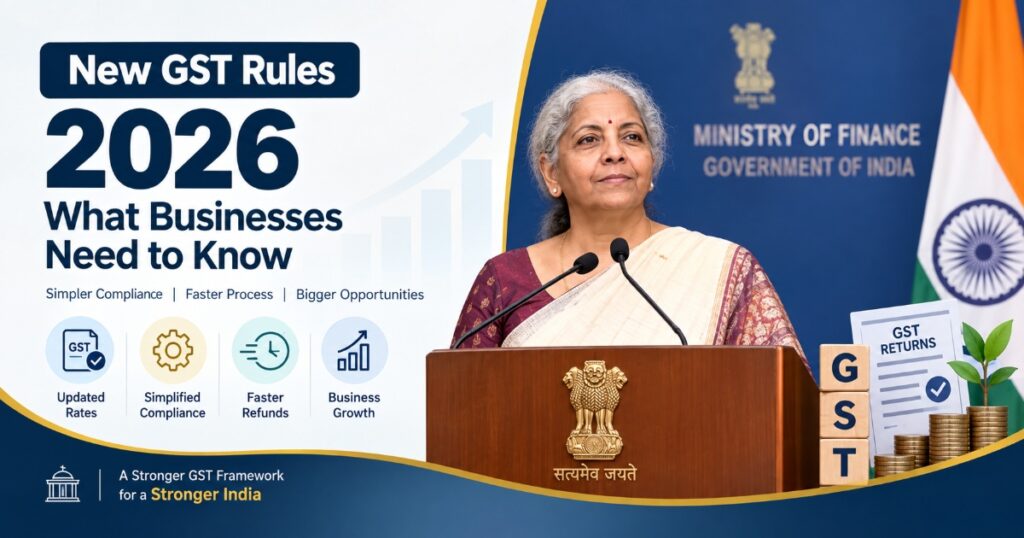
The proposed measures focus on reducing procedural difficulties, improving working capital availability and making tax administration more predictable. However, a New GST Rules 2026 recommendation does not automatically become an enforceable legal provision. Businesses should verify the relevant amendments, notifications, commencement dates and portal instructions before changing their compliance practices.
This article explains the major GST developments announced in October 2026, their potential business impact and the practical steps taxpayers should consider.
Need Help Understanding the Latest GST Changes?
Stay prepared for the latest GST compliance developments with JJJ & Company LLP. Our professional advisory support helps businesses review GST obligations, manage tax compliance, reconcile input tax credit and prepare for regulatory changes.
1. Major GST Council Recommendations in October 2026
The 57th GST Council meeting focused substantially on procedural reforms rather than only tax-rate changes. Key recommendations included:
- Simplifying GST registration for eligible small suppliers selling through e-commerce platforms.
- Improving reconciliation between GST returns and reducing avoidable mismatch notices.
- Introducing more automated processing of eligible GST refunds.
- Expanding certain categories of input tax credit refunds.
- Reducing the proposed maximum general penalty under Section 125.
- Raising the prosecution threshold from ₹1 crore to ₹5 crore.
- Recommending withdrawal of arrest provisions under Section 69 of the CGST Act.
- Standardising GST notices and proceedings.
- Facilitating certain exports of services.
- Considering an optional compliance scheme for eligible small businesses with turnover up to ₹5 crore.
These proposals may affect different taxpayers in different ways. Their actual benefits will depend on the final legal provisions, eligibility conditions and implementation dates.
2. GST Registration Changes for Small E-Commerce Sellers
One of the important recommendations concerns small suppliers selling goods through e-commerce operators in states or Union Territories where they do not have a physical business presence.
The Council recommended a simplified registration mechanism through proposed Rule 14B of the CGST Rules, subject to specified conditions.
Under the proposed mechanism, eligible small suppliers may be able to declare an e-commerce operator’s warehouse in the relevant state or Union Territory as their principal place of business for registration purposes. Automatic system-based registration would be available subject to the prescribed requirements, including the applicable input tax credit condition.
How could this help businesses?
- Small sellers may find it easier to expand sales across state borders.
- Businesses may face fewer administrative barriers when entering new markets.
- Eligible sellers could avoid establishing a separate physical office solely to meet the relevant registration requirement.
- E-commerce businesses may find interstate expansion more manageable.
However, this is not a blanket exemption from GST registration. Sellers must verify their eligibility, applicable registration requirements, e-commerce conditions and other state-specific obligations before relying on the proposed facility.
3. GST Return Filing and Reconciliation Reforms
Errors and inconsistencies between outward supply details, tax liability and input tax credit are common reasons for GST notices and additional compliance work.
The Council recommended improvements to Forms GSTR-1, GSTR-1A, the Invoice Furnishing Facility (IFF) and GSTR-3B to improve reconciliation between reported transactions and tax liability.
The proposals also include a mechanism for more accurate reporting of reverse charge mechanism (RCM) transactions and an electronic statement of tax paid under reverse charge and ITC claimed.
Further, changes to the reporting of payments through Form GST DRC-03 were recommended to capture details of the underlying invoice.
What should businesses do now?
Businesses should continue to:
- Reconcile sales invoices with GSTR-1 and GSTR-3B.
- Compare purchase records with available supplier-reported invoice data.
- Review eligible ITC before claiming credit.
- Check reverse charge liabilities and related payments.
- Maintain invoice-level records supporting voluntary tax payments.
- Correct discrepancies within the applicable statutory framework.
The recommended alternative return correction mechanism is intended to reduce avoidable mismatches and notices. The Council recommended bringing specified changes into force from the April 2027 return period, subject to the final implementation process.
4. Faster GST Refund Processing and Improved Working Capital
GST refunds can have a significant effect on cash flow, especially for exporters, businesses with accumulated input tax credit and taxpayers facing an inverted duty structure.
The Council recommended amendments to Section 54 of the CGST Act and relevant rules to facilitate system-based processing and sanctioning of eligible refund claims.
The proposed framework covers refunds relating to:
- Excess balances in the electronic cash ledger.
- Zero-rated supplies, subject to the applicable conditions.
- Inverted duty structure situations.
- Other eligible refund categories covered by the relevant legal provisions.
Faster processing could help businesses reduce the time their funds remain tied up in tax-related balances. This may be particularly useful for export-oriented companies and manufacturers with substantial input tax credit accumulation.
Nevertheless, automated processing does not mean every refund will be approved without scrutiny. Taxpayers should maintain correct invoices, payment evidence, shipping documents where relevant, reconciliation statements and other prescribed supporting records.
5. Wider Input Tax Credit Refund Eligibility
Input tax credit is an essential component of the GST system because it helps prevent cascading taxation on eligible business purchases.
The Council recommended expanding refund eligibility for accumulated ITC relating to capital goods and input services in specified situations.
The proposed changes include:
- Refund of accumulated ITC relating to capital goods in certain zero-rated supply cases.
- Refund of accumulated ITC relating to input services and capital goods in specified inverted duty structure cases.
This could be relevant to manufacturers, exporters, infrastructure businesses and other eligible taxpayers with substantial investment or input costs.
Businesses should not assume that every capital expenditure or input service automatically qualifies for a refund. Eligibility will depend on the applicable statutory provisions, exclusions, documentation and prescribed calculation methodology.
6. Proposed Reduction in the General GST Penalty
The GST Council recommended reducing the maximum general penalty under Section 125 of the CGST Act from ₹25,000 to ₹10,000.
Section 125 deals with contraventions for which a separate penalty is not specifically provided under the Act.
If implemented through the required legal amendments, the proposed reduction could reduce the maximum general penalty exposure for certain covered contraventions.
However, it should not be interpreted as a universal reduction in all GST penalties. Specific penalties for offences such as particular return defaults, fraudulent ITC claims, tax evasion or other statutory violations may be governed by separate provisions.
Businesses should identify the exact section applicable to an alleged default before calculating the potential penalty or deciding how to respond to a notice.
7. Proposed Changes to GST Prosecution and Arrest Provisions
The Council recommended raising the prosecution threshold from ₹1 crore to ₹5 crore and withdrawing arrest powers under Section 69 of the CGST Act through the recommended legislative changes.
These proposals form part of a broader effort to distinguish between compliance-related difficulties and serious tax fraud while retaining mechanisms to address deliberate evasion.
The proposed changes may be significant for businesses concerned about the consequences of GST investigations and alleged offences.
Nevertheless, taxpayers should not interpret these recommendations as immunity from prosecution, investigation, recovery or other enforcement action. Their legal effect depends on the enacted amendments, applicable commencement dates and the nature of the alleged violation.
Businesses facing a GST investigation, summons or show-cause notice should obtain professional advice promptly and preserve the relevant accounting, invoice and transaction records.
8. Easier Access to GST Appeals and Standardised Notices
The Council recommended measures to make GST proceedings more consistent and reduce unnecessary litigation.
These include common standards for notices and proceedings, along with a proposed upper limit of ₹40 crore on the pre-deposit payable in specified penalty-only cases when filing appeals before the Appellate Authority or Appellate Tribunal, as applicable.
The recommendation concerns cases where the order involves a penalty without a demand of tax. It should not be treated as a universal cap applicable to every GST appeal.
For businesses, standardised documentation and clearer procedures could improve the ability to understand allegations, prepare evidence and respond within prescribed timelines.
Taxpayers receiving a notice should check the issuing authority, relevant tax period, legal provisions, reply deadline, supporting documents and available appeal remedies. Missing a deadline can have consequences even where the taxpayer disputes the underlying demand.
9. GST Reforms for Exporters and Service Providers
The Council recommended changes intended to facilitate exports of services and clarify certain place-of-supply and foreign payment issues.
The proposals include removing a condition relating to establishments of distinct persons from the definition of export of services and clarifying certain cases involving payment in foreign currency or Indian rupees where permitted.
Another recommendation concerns place-of-supply rules for specified services involving goods made physically available to the supplier. The proposed change may allow the default rule under Section 13(2) of the IGST Act to apply in the relevant cases.
These changes could be relevant to Indian IT companies, consultants, engineering businesses, service exporters and companies operating through foreign branches.
Exporters should continue reviewing the contractual arrangement, identity and location of the recipient, place of supply, payment evidence, invoices, Letter of Undertaking (where applicable) and refund eligibility. The classification of a transaction as an export of services must be established under the applicable law rather than assumed solely because the customer is located outside India.
10. Proposed Optional Annual Return Quarterly Payment Scheme
The Council approved in principle a concept for an optional Annual Return Quarterly Payment (ARQP) scheme for eligible taxpayers with aggregate turnover of up to ₹5 crore in the preceding financial year who deal exclusively in supplies to unregistered persons, or B2C supplies.
The scheme is intended to simplify compliance for eligible small consumer-facing businesses.
Potentially relevant businesses may include qualifying retailers and other enterprises whose supplies fall within the prescribed conditions.
However, approval in principle does not itself establish the complete operating rules. Taxpayers should wait for the detailed framework covering eligibility, payment frequency, returns, exclusions and implementation before changing their filing practices.
11. Other Compliance Areas Businesses Should Monitor
In addition to the headline recommendations, businesses should review the implications of proposed changes relating to:
Reverse charge mechanism: Verify the correct tax liability, payment evidence and ITC eligibility for applicable transactions.
E-invoicing: Monitor the proposed extension concerning specified supplies received from unregistered persons under reverse charge and imports of services for taxpayers with aggregate annual turnover of ₹5 crore or more. Check the final notification and scope before implementation.
Movement of goods: Follow prescribed e-way bill, invoice, transport and documentation requirements. The recommended measures for authorised, intelligence-based interception do not remove existing lawful verification obligations.
GST notices: Maintain a central register of notices, reply dates, hearing dates and appeal deadlines.
Record keeping: Retain sales and purchase registers, invoices, credit notes, debit notes, bank statements, reconciliations and relevant supporting documents in accordance with applicable law.
GST portal monitoring: Check official notifications and portal advisories regularly rather than relying only on news reports or summaries.
12. How Businesses Can Prepare for the New GST Framework
Businesses can take the following practical steps while the recommended changes move through the legal and administrative process:
- Conduct a GST compliance review: Identify return filing, registration, ITC and documentation gaps.
- Reconcile monthly records: Compare books of account with GST returns and available supplier data.
- Review refund opportunities: Check whether accumulated ITC or excess cash balances qualify for refunds under existing law and any subsequently notified changes.
- Assess export transactions: Review contracts, place of supply, payment records and supporting export documentation.
- Update internal controls: Assign responsibility for return preparation, approval, payment and notice management.
- Track legal implementation: Record the notification number, effective date and relevant conditions for each change before applying it.
- Train finance teams: Communicate new requirements to accounting staff, procurement teams, sales teams and business owners.
Early preparation can help businesses identify compliance risks without prematurely applying proposed provisions.
Why Professional GST Advisory Matters
GST compliance involves more than filing returns. Businesses must interpret statutory provisions, reconcile transactions, assess ITC eligibility, manage refunds, respond to notices and monitor regulatory amendments.
A structured review can help identify discrepancies, improve documentation and establish a more reliable compliance process. The right approach depends on the business’s turnover, supply model, industry, registration status and transaction profile.
Preparing Your Business for the Latest GST Changes?
JJJ & Company LLP provides professional support for GST compliance reviews, return reconciliation, input tax credit assessment, refund documentation, GST notice assistance and tax advisory.
Get help understanding which changes may affect your business and which requirements remain applicable under current law.
Frequently Asked Questions (FAQs)
1. What are the latest GST rules announced in October 2026?
The 57th GST Council meeting recommended changes relating to registration, returns, refunds, ITC, penalties, prosecution, appeals, e-commerce sellers and export-related compliance. The legal effect of each recommendation depends on the relevant amendments and notifications.
2. Has the general GST penalty been reduced to ₹10,000?
The Council recommended reducing the maximum general penalty under Section 125 from ₹25,000 to ₹10,000. Taxpayers should verify the final legal amendment and effective date before applying the proposed limit.
3. Will GST refunds become faster?
The Council recommended system-based processing and sanctioning of eligible refunds. Actual processing will depend on the applicable provisions, eligibility requirements, supporting documents and implementation.
4. Are small e-commerce sellers exempt from GST registration?
No blanket exemption has been announced by this recommendation. A simplified registration mechanism was proposed for eligible small suppliers, subject to specified conditions. Sellers should confirm their eligibility and applicable registration obligations.
5. Will the proposed ITC changes benefit exporters?
The recommendations include wider refund eligibility for specified accumulated ITC in certain zero-rated supply cases. Exporters must still satisfy the applicable statutory and documentary conditions.
6. What should a business do after receiving a GST notice?
Review the notice carefully, identify the relevant tax period and legal provisions, collect supporting records and respond within the prescribed deadline. Professional advice may be appropriate for complex disputes or significant tax exposure.
7. Where can businesses verify official GST updates?
Businesses should consult the Ministry of Finance, the Central Board of Indirect Taxes and Customs (CBIC), official GST notifications and the GST portal for authoritative updates.
Conclusion: Stay Prepared for GST Compliance Changes in 2026
The recommendations from the 57th GST Council meeting indicate a continued focus on simplifying compliance, improving refund processes, facilitating eligible input tax credit and reducing avoidable disputes.
For businesses, the priority should be to maintain accurate records, reconcile GST returns, review refund eligibility, monitor notices and understand the legal status of each proposed change. The benefits of these reforms will depend on their final implementation and the taxpayer’s eligibility.
Need Professional Assistance With GST Compliance, Refunds or Tax Notices?
JJJ & Company LLP can help businesses assess their GST compliance position, review applicable requirements and prepare for regulatory changes through professional tax advisory and compliance support.
JJJ & Company LLP — GST Compliance and Tax Advisory