

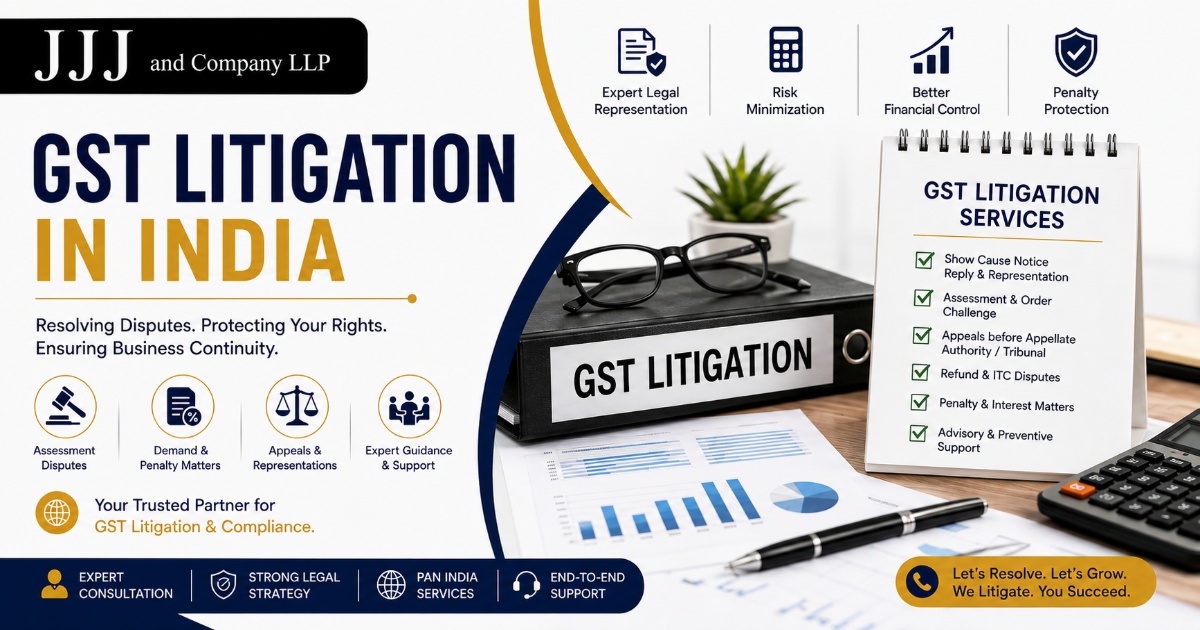
Receiving a GST notice can be stressful for any business. Whether you operate as a private limited company, LLP, partnership firm, proprietorship, startup, or large enterprise, a tax notice should never be ignored.
A GST notice may relate to input tax credit (ITC), tax liability, classification, valuation, return discrepancies, registration issues, interest, penalty, or alleged non-compliance. If the matter progresses, it can move from a Show Cause Notice (SCN) to adjudication, appeal and, where applicable, proceedings before the Goods and Services Tax Appellate Tribunal (GSTAT).
Understanding the GST litigation process early can help a taxpayer protect its rights, meet statutory deadlines and prepare a stronger response.
What Happens After Receiving a GST Notice?
In simple terms, the GST dispute process generally follows this path:
GST Notice Receive → Reply to SCN → Personal Hearing → Adjudication Order → First Appeal → GSTAT → High Court / Supreme Court, where legally maintainable
A GST notice does not automatically mean that the tax department’s allegations are correct. The taxpayer has an opportunity to examine the allegations, submit evidence, explain the facts and contest the proposed demand where appropriate.
The exact procedure and available remedies depend on the type of notice, section involved, order passed, facts of the case and applicable GST provisions.
What Is a GST Notice?
A GST notice is a formal communication issued by the tax authorities when clarification, information, payment or further action is required from a registered person or taxpayer.
For example, a Company or LLP may receive a notice because of:
- Difference between GST returns and other information available with the department
- Questions relating to Input Tax Credit
- Mismatch involving purchase and sales data
- Incorrect classification of goods or services
- Questions regarding tax liability
- Delayed filing or payment
- Issues relating to GST registration
- Alleged suppression or incorrect disclosure
- Interest or penalty proceedings
- Audit or investigation findings
The first step should always be to understand what the notice alleges, which tax period is involved, what provision has been invoked and what response is required.
What Is a Show Cause Notice (SCN) Under GST?
A Show Cause Notice (SCN) is an important stage in GST proceedings. It generally communicates the department’s proposed action and gives the taxpayer an opportunity to explain why the proposed demand, interest or penalty should not be confirmed.
An SCN should not simply be treated as a routine letter.
For a company, LLP or other business, the response can become an important part of the eventual litigation record. Therefore, the taxpayer should carefully analyse:
- The allegations made in the notice
- The relevant GST provisions
- The tax period involved
- The proposed tax demand
- Interest and penalty proposed
- Documents relied upon by the department
- Whether the allegations are factually correct
- Whether the notice has been issued within the applicable legal framework
- The evidence available with the taxpayer
- The deadline for submitting the response
A properly structured reply can help address the dispute before it develops into a prolonged litigation matter JJJ and company LLP provide Expert support.
How Should a Business Respond to a GST Notice?
The biggest mistake a business can make is to ignore a GST notice until the deadline has passed.
A practical approach is:
1. Review the Notice Carefully
Read the notice from beginning to end. Identify the section, tax period, allegations, proposed demand and deadline.
2. Reconcile the Tax Data
For example, an LLP receiving an ITC-related notice should reconcile its purchase records, invoices, GST returns, books of accounts and other relevant records.
3. Identify the Actual Dispute
Sometimes the issue may arise because of a data mismatch rather than an intentional tax violation. Understanding the actual reason behind the discrepancy is essential.
4. Collect Supporting Documents
Depending on the dispute, documents may include:
- Tax invoices
- Purchase and sales records
- GST returns
- Electronic records
- Agreements
- Payment evidence
- E-way bills
- E-invoices
- Ledger accounts
- Reconciliation statements
- Correspondence with customers or suppliers
5. Prepare a Legally Supported Reply
The response should address the allegations point-by-point instead of providing a generic explanation.
6. Attend the Personal Hearing Where Required
If a personal hearing is provided or required, the taxpayer should present the facts and legal arguments clearly.
What Happens If the GST Department Passes an Adverse Order?
If the adjudicating authority passes an order against the taxpayer, the taxpayer may have an appellate remedy depending on the circumstances.
Under Section 107 of the CGST Act, an aggrieved person may appeal against a decision or order of an adjudicating authority to the prescribed Appellate Authority. The statutory framework provides a three-month period from communication of the decision or order for filing such an appeal, subject to the applicable provisions.
This makes timely action extremely important.
A Company or LLP should not wait until the final days to decide whether an appeal is required. The order should be reviewed as soon as it is received so that the available legal remedies can be evaluated.
GST First Appeal: What Should Taxpayers Know?
The first appeal is an important opportunity to challenge an adverse adjudication order.
The appeal may involve issues such as:
- Wrong demand of GST
- Incorrect rejection of ITC
- Incorrect classification
- Dispute regarding valuation
- Interest calculation
- Penalty
- Interpretation of GST provisions
- Failure to consider evidence
- Procedural or jurisdictional issues
The taxpayer needs to prepare appropriate grounds of appeal, supporting documents and relevant legal arguments.
The GST Council’s published guidance notes that an appeal under Section 107 is filed in the prescribed form and that the applicable pre-deposit requirements can affect recovery proceedings.
Therefore, GST litigation is not simply about filing an appeal. The quality of the grounds, documentation, reconciliation and legal representation can be critical.
When Does a GST Dispute Reach GSTAT?
The Goods and Services Tax Appellate Tribunal (GSTAT) is the second appellate level within the GST framework.
The GST Council has described GSTAT as the forum for appeals against orders of GST Appellate Authorities. The framework covers disputes arising under the Central, State, Union Territory and Integrated GST laws.
Under Section 112, an aggrieved person may appeal to the Appellate Tribunal against an order passed under Section 107 or 108, subject to the statutory requirements and applicable timelines.
The GSTAT procedural framework provides for online filing of appeals along with the relevant documents through the GSTAT portal.
For businesses, this is significant because GST disputes can involve substantial financial exposure. A well-prepared GSTAT appeal should therefore present the facts, grounds of appeal, documentary evidence and legal position in a structured manner.
GST Litigation Issues Commonly Faced by Companies and LLPs
Different businesses face different GST disputes. Some of the commonly litigated areas include:
Input Tax Credit Disputes
ITC-related disputes can arise due to questions concerning eligibility, documentation, supplier-related issues, reconciliation or other statutory conditions.
Classification Disputes
A disagreement over whether a product or service falls under one GST classification or another can significantly affect the applicable tax rate.
Taxability Disputes
Businesses may face questions about whether a particular transaction or supply is taxable, exempt or subject to a specific treatment.
Valuation Issues
Disputes may arise regarding the value on which GST should be calculated.
Interest and Penalty
A taxpayer may also need to contest the computation or applicability of interest and penalties depending on the facts and legal provisions.
Demand Proceedings
Where the department proposes or confirms a tax demand, businesses may need professional assistance to evaluate the demand and determine the appropriate response or appellate remedy.
Why Professional GST Litigation Assistance Matters
GST litigation requires more than simply preparing a reply.
A strong litigation strategy generally involves:
Fact Analysis → Tax Reconciliation → Document Review → Legal Research → Drafting → Representation → Appeal Strategy
For example, if an LLP receives a substantial ITC-related demand, simply arguing that the credit is genuine may not be enough. The business may need to establish the transaction trail through invoices, books, GST returns, payment records and other evidence while addressing the specific legal allegations raised by the department.
Similarly, a private limited company facing a classification dispute may require a combination of transaction analysis, GST law research, supporting documentation and appropriate representation.
Early professional review can help identify weaknesses in the department’s case as well as weaknesses in the taxpayer’s documentation.
GST Litigation: A Practical Checklist for Businesses
If your Company, LLP or business receives a GST notice, consider the following checklist:
Check the notice date and response deadline
Identify the GST section involved
Understand the exact allegation
Reconcile GST returns with books and records
Preserve relevant invoices and supporting documents
Prepare a point-by-point response
Evaluate the possibility of personal hearing
Review any adjudication order immediately
Check the applicable appeal deadline
Prepare appropriate grounds of appeal
Evaluate pre-deposit and other procedural requirements
Consider GSTAT or further judicial remedies where applicable
Most importantly, do not ignore a GST notice simply because the business believes the demand is incorrect. A legally incorrect demand still requires a timely and properly documented response.
GST Litigation Is About Strategy, Not Just Compliance
GST compliance helps prevent disputes, but once litigation begins, the approach needs to change.
A business must move from simply asking:
“What tax should we pay?”
to:
“What exactly is the dispute, what does the law provide, what evidence supports our position, and what is the appropriate legal remedy?”
That is why GST litigation should be approached strategically.
The GSTAT framework has developed significantly, with the Principal Bench at New Delhi and State Benches established under the GST framework. The GST Council has also published procedural rules governing the functioning and filing process before GSTAT.
Final Thoughts
A GST notice does not necessarily mean that a taxpayer has lost its case. It is often the beginning of a process in which the taxpayer can present facts, evidence and legal arguments.
From SCN response to adjudication, first appeal and GSTAT proceedings, every stage requires attention to deadlines, documentation and the applicable legal provisions.
Whether you are operating a Company, LLP, partnership, startup or established enterprise, taking professional advice at the early stage of a GST dispute can help you understand your position and choose an appropriate course of action.
If your business has received a GST notice, Show Cause Notice, demand order or adverse appellate order, professional GST litigation assistance can help you assess the matter, prepare the necessary response and evaluate available appellate remedies.
Need assistance with a GST dispute? Explore professional GST Litigation Services and get your matter reviewed by experienced tax professionals.
Frequently Asked Questions (FAQs)
1. What should I do after receiving a GST notice?
First, check the notice date, deadline, section involved, allegations and proposed demand. Then review the relevant records and prepare an appropriate response within the prescribed timeline.
2. What is a GST Show Cause Notice?
An SCN generally communicates the department’s proposed action and provides the taxpayer an opportunity to explain why the proposed demand, interest or penalty should not be confirmed.
3. Can a Company challenge a GST demand?
Yes, subject to the applicable provisions and facts of the case, a taxpayer may have appellate or other legal remedies against an adverse GST order.
4. What is the time limit for a GST first appeal?
Section 107 generally provides a three-month period from communication of the relevant order for an appeal by an aggrieved person, subject to the applicable statutory provisions.
5. What is GSTAT?
GSTAT stands for Goods and Services Tax Appellate Tribunal. It functions as the second appellate forum in the GST dispute-resolution framework.
6. Can an LLP file a GST appeal?
Yes. An LLP that is an aggrieved taxpayer may pursue available appellate remedies subject to the applicable GST provisions, facts and procedural requirements.
7. Why should a GST notice not be ignored?
Ignoring a notice can result in missed deadlines and may limit the taxpayer’s ability to effectively present its position. Immediate review is therefore advisable.
8. Can GST litigation reach the High Court?
In appropriate cases, further judicial remedies may be available after the relevant GST appellate process, depending on the nature of the dispute and applicable law.