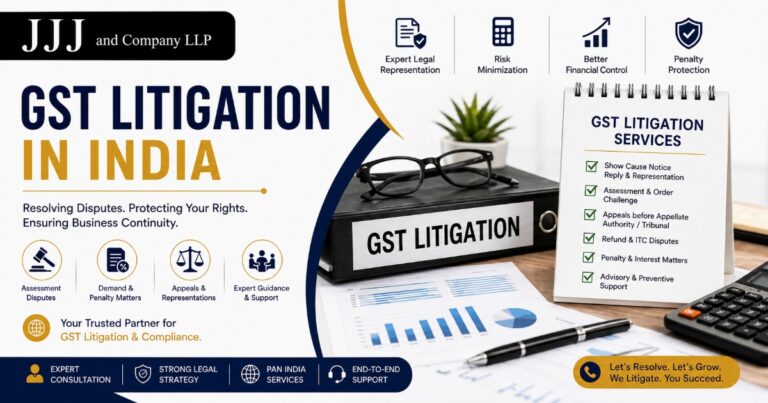

Running a business in India involves more than timely GST registration and return filing. Businesses today face increasing scrutiny from GST authorities through notices, audits, assessments, investigations, and enforcement actions. Even businesses with strong compliance systems may receive notices due to return mismatches, input tax credit (ITC) issues, e-way bill discrepancies, or interpretation of GST provisions.
Receiving a GST notice can be stressful, but it does not always indicate wrongdoing. What matters is responding correctly, submitting proper documentation, and presenting your case effectively before the GST authorities.
This is where GST Representation & Litigation Services become essential. Professional representation ensures your business complies with legal requirements, protects its rights, minimizes penalties, and resolves disputes efficiently.
At JJJ and Company LLP, we assist businesses across India with GST notices, departmental proceedings, appeals, assessments, adjudication, and litigation. Our experienced Chartered Accountants help clients navigate complex GST laws while protecting their commercial interests and ensuring compliance.
What is GST Representation?
GST Representation refers to representing a taxpayer before GST authorities during various proceedings, including:
- GST Notice Replies
- Scrutiny Proceedings
- GST Assessments
- Departmental Audits
- Investigations
- Show Cause Notice (SCN) Hearings
- Personal Hearings
- GST Appeals
- Rectification Applications
- Advance Ruling Proceedings
A professional GST representative prepares legal submissions, compiles supporting documents, appears before tax authorities, and ensures that the taxpayer’s position is presented accurately and effectively.
What is GST Litigation?
GST Litigation involves resolving disputes between taxpayers and GST authorities through legal proceedings.
Litigation may arise due to:
- Tax demand notices
- Wrongful denial of Input Tax Credit (ITC)
- Classification disputes
- Incorrect GST rate application
- Refund rejection
- Registration cancellation
- E-way bill violations
- Penalty orders
- Anti-profiteering issues
- Interpretation of GST law
Professional litigation support helps businesses defend their position, challenge incorrect orders, and reduce unnecessary tax liabilities.
Why Businesses Receive GST Notices
Many business owners assume receiving a GST notice means they have violated the law. In reality, notices are often issued automatically based on system-generated mismatches or routine compliance checks.
Some common reasons include:
Return Mismatches
Differences between:
- GSTR-1
- GSTR-3B
- GSTR-2B
- E-way Bills
can trigger notices.
Incorrect Input Tax Credit (ITC)
Improper ITC claims remain one of the most common reasons for GST disputes.
Authorities may question:
- Fake invoices
- Blocked credits
- Ineligible ITC
- Supplier non-compliance
- Duplicate claims
Non-Filing or Delayed Filing
Businesses that fail to file returns on time may receive notices relating to:
- Pending returns
- Interest liability
- Late fees
- Registration cancellation
GST Audit Findings
Departmental audits frequently identify:
- Underreported turnover
- Incorrect tax payment
- Wrong exemptions
- Improper documentation
These findings often lead to further proceedings.
E-Way Bill Violations
Errors in transportation documentation, expired e-way bills, or incorrect vehicle details may result in penalties and legal proceedings.
Refund Verification
Businesses claiming GST refunds may receive notices requesting:
- Additional documentation
- Invoice verification
- Export proof
- Bank realization certificates
Common Types of GST Notices
Understanding the type of notice received is the first step toward an appropriate response.
1. Scrutiny Notice
Issued when discrepancies are observed in GST returns.
The taxpayer must explain the mismatch and submit supporting documents within the prescribed time.
2. Show Cause Notice (SCN)
One of the most common notices under GST.
Authorities issue an SCN when they believe tax has been:
- Short paid
- Not paid
- Incorrectly refunded
- Wrongly claimed as ITC
A detailed legal reply is essential.
3. Assessment Notice
Assessment proceedings may be initiated where authorities determine tax liability based on available information.
Proper representation helps ensure that all facts and supporting records are considered before any order is passed.
4. Audit Notice
GST officers may conduct departmental audits to verify:
- Books of accounts
- GST returns
- Invoices
- Tax payments
- Input Tax Credit
- Compliance records
Professional assistance during audits significantly reduces compliance risks.
5. Registration Cancellation Notice
Businesses may receive cancellation notices due to:
- Non-filing of returns
- Business closure
- Incorrect registration details
- Suspected fraud
Immediate response is crucial to avoid disruption of business operations.
6. Demand Notice
Demand notices are issued where tax, interest, or penalties are alleged to be payable.
Ignoring these notices can lead to recovery proceedings and additional penalties.
Importance of Responding to GST Notices on Time
Ignoring a GST notice can have serious financial and legal consequences.
Possible outcomes include:
- Heavy penalties
- Interest liability
- Tax recovery proceedings
- Bank account attachment
- Cancellation of GST registration
- Denial of Input Tax Credit
- Business disruptions
- Legal proceedings
Submitting a timely, well-supported reply greatly improves the chances of resolving the matter without prolonged litigation.
How JJJ and Company LLP Helps Businesses
At JJJ and Company LLP, we provide end-to-end GST Representation Services designed to protect businesses during every stage of GST proceedings.
Our professionals assist clients by:
- Reviewing GST notices and departmental communications
- Analysing legal and factual issues
- Preparing detailed replies supported by documentary evidence
- Representing clients before GST officers
- Assisting during departmental audits and investigations
- Advising on compliance improvements to reduce future disputes
- Supporting businesses in appeals and litigation where required
Our practical, business-focused approach helps clients resolve disputes efficiently while maintaining regulatory compliance.
Documents Commonly Required for GST Representation
Depending on the nature of the notice, businesses may need to provide:
- GST Registration Certificate
- GST Returns (GSTR-1, GSTR-3B, GSTR-9)
- Purchase and Sales Registers
- Tax Invoices
- E-Way Bills
- Input Tax Credit Records
- Bank Statements
- Books of Accounts
- Customer and Supplier Agreements
- Previous GST Orders or Notices
- Reconciliation Statements
- Supporting Correspondence
Proper documentation strengthens your case and helps ensure a more effective representation before GST authorities.
GST Adjudication Process Under GST
After a taxpayer submits a reply to a GST notice, the GST officer examines the facts, supporting documents, and legal provisions before passing an order. This process is known as GST Adjudication.
The adjudicating authority may:
- Accept the taxpayer’s explanation and close the proceedings.
- Partially accept the reply and revise the tax demand.
- Reject the explanation and issue a tax demand along with applicable interest and penalties.
- Seek additional documents or clarification before passing the final order.
Professional representation during adjudication helps ensure that all facts are presented effectively, reducing the possibility of unnecessary tax demands or prolonged litigation.
GST Appeal Process in India
If a taxpayer is dissatisfied with an order passed by the GST authority, the law provides a structured appeal mechanism.
The appeal hierarchy generally includes:
First Appeal
An appeal can be filed before the Appellate Authority within the prescribed time limit after receiving the adjudication order.
GST Appellate Tribunal (GSTAT)
If the taxpayer is not satisfied with the appellate authority’s decision, the matter may be taken before the GST Appellate Tribunal, subject to applicable legal provisions.
High Court
Matters involving substantial questions of law may be challenged before the jurisdictional High Court.
Supreme Court of India
Certain matters involving significant legal questions can ultimately be appealed before the Supreme Court.
Each stage requires proper documentation, legal interpretation, and compliance with statutory timelines. Missing deadlines or submitting incomplete records can weaken the taxpayer’s case.
Common GST Disputes Faced by Businesses
GST litigation generally arises from one or more of the following issues:
1. Input Tax Credit (ITC) Disputes
Disagreements regarding eligibility, blocked credits, supplier compliance, or documentation.
2. Classification of Goods and Services
Incorrect HSN or SAC classification may lead to higher tax demands.
3. Wrong GST Rate Applied
Businesses may inadvertently apply an incorrect GST rate, resulting in tax shortfalls or excess payments.
4. GST Refund Rejection
Exporters and businesses claiming refunds often face delays or rejection due to documentation deficiencies or procedural issues.
5. Registration Cancellation
Non-filing of returns, non-compliance, or alleged irregularities may lead to GST registration cancellation proceedings.
6. E-Way Bill Violations
Errors in e-way bills or transportation documents can result in penalties and detention of goods.
7. Anti-Profiteering Matters
Businesses may face investigations where authorities believe GST benefits were not passed on to consumers.
Best Practices to Avoid GST Litigation
Although not every dispute can be prevented, businesses can significantly reduce litigation risks by adopting strong compliance practices.
Maintain Accurate Books of Accounts
Ensure all financial records, invoices, purchase registers, and sales registers are updated and reconciled regularly.
File GST Returns on Time
Timely filing reduces the likelihood of notices relating to delayed compliance.
Reconcile GST Returns Regularly
Perform periodic reconciliation between:
- GSTR-1
- GSTR-3B
- GSTR-2B
- Books of Accounts
- E-Way Bills
This helps identify discrepancies before they attract departmental attention.
Verify Input Tax Credit
Claim ITC only after confirming supplier compliance and verifying supporting documents.
Preserve Documentation
Maintain invoices, contracts, payment proofs, transport documents, and GST records for the prescribed period.
Conduct Periodic GST Reviews
Regular internal GST reviews help identify compliance gaps before they develop into litigation.
Seek Professional Advice
Consult experienced Chartered Accountants before responding to notices or making significant GST decisions.
Why Professional GST Representation Matters
GST law is continuously evolving through amendments, notifications, circulars, and judicial decisions. Handling notices without professional guidance can expose businesses to unnecessary financial risks.
Professional GST representation provides:
- Proper interpretation of GST law
- Legally sound replies
- Strong documentary support
- Timely compliance
- Representation during hearings
- Reduced penalty exposure
- Improved chances of successful dispute resolution
- Strategic litigation support
- Compliance improvement recommendations
- Long-term risk management
Professional assistance often saves businesses substantial time, costs, and potential tax liabilities.
Why Choose JJJ and Company LLP?
JJJ and Company LLP is committed to helping businesses navigate India’s complex GST framework with confidence.
Our team of experienced Chartered Accountants provides comprehensive GST advisory, representation, and litigation support across multiple industries.
Our GST Services Include
- GST Representation Services
- GST Litigation Services
- GST Notice Reply & Response
- Show Cause Notice (SCN) Assistance
- GST Appeals
- GST Assessment Support
- GST Audit Assistance
- GST Registration & Cancellation Matters
- GST Refund Advisory
- Input Tax Credit Advisory
- GST Compliance Management
- GST Health Check & Review
- Indirect Tax Advisory
- GST Risk Assessment
- Departmental Representation Before GST Authorities
Whether you are a startup, MSME, exporter, manufacturer, service provider, or multinational company, our professionals deliver practical, commercially focused solutions tailored to your business needs.
Conclusion
GST compliance has become increasingly complex, and businesses must be prepared to respond effectively to notices, audits, assessments, and legal proceedings. Ignoring a GST notice or submitting an incomplete reply can result in significant tax demands, penalties, and business disruptions.
A proactive approach, supported by experienced professionals, can help businesses resolve disputes efficiently while protecting their financial interests and maintaining regulatory compliance.
At JJJ and Company LLP, we combine technical expertise with practical business understanding to help clients manage GST disputes confidently and achieve timely resolutions.
If your business has received a GST notice or requires assistance with appeals, audits, or litigation, our experts are ready to provide strategic guidance and professional representation.
Contact JJJ and Company LLP
Facing a GST Notice or Tax Dispute?
Don’t let GST litigation affect your business operations.
JJJ and Company LLP offers comprehensive GST Representation & Litigation Services to help businesses respond to notices, handle departmental proceedings, file appeals, and resolve disputes efficiently.
Contact our GST experts today for professional advice and reliable representation before GST authorities.
Frequently Asked Questions (FAQs)
1. What is GST Representation?
GST Representation involves representing taxpayers before GST authorities during notices, audits, assessments, hearings, appeals, and other proceedings.
2. What is GST Litigation?
GST Litigation refers to resolving disputes between taxpayers and GST authorities through adjudication, appeals, tribunals, or courts.
3. What should I do after receiving a GST notice?
Review the notice carefully, collect supporting documents, and seek professional advice before submitting your reply within the prescribed timeline.
4. Can a Chartered Accountant represent me before GST authorities?
Yes. Chartered Accountants can represent taxpayers before GST authorities in accordance with applicable legal provisions.
5. What happens if I ignore a GST notice?
Ignoring a notice may lead to tax demands, interest, penalties, recovery proceedings, attachment of bank accounts, or cancellation of GST registration.
6. How long do I have to reply to a GST notice?
The reply period varies depending on the type of notice. Businesses should always comply within the timeline mentioned in the notice.
7. Can I appeal against a GST order?
Yes. Taxpayers can challenge eligible GST orders before the appropriate appellate authority within the prescribed limitation period.
8. What documents are required for GST litigation?
Common documents include GST returns, invoices, purchase and sales registers, contracts, reconciliation statements, bank records, e-way bills, and previous departmental correspondence.
9. Why is professional GST representation important?
Professional representation helps ensure legally sound submissions, timely compliance, effective hearings, and stronger dispute resolution.
10. Why choose JJJ and Company LLP for GST Representation & Litigation?
JJJ and Company LLP provides experienced Chartered Accountants, personalized advisory, end-to-end representation, strategic litigation support, and practical compliance solutions that help businesses manage GST disputes efficiently.