

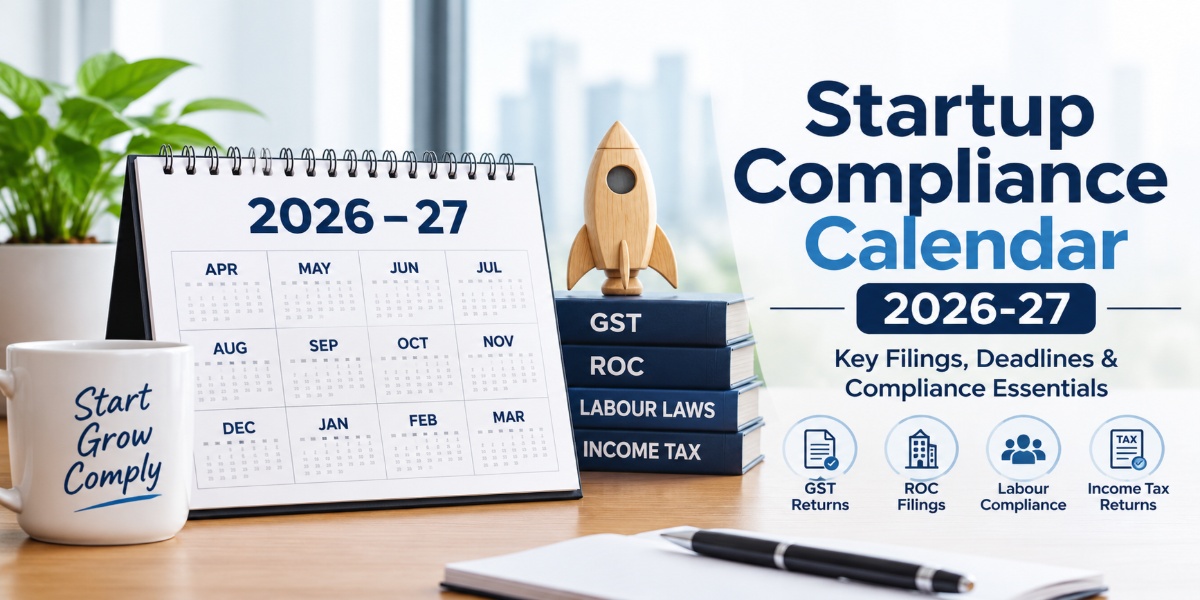
Running a startup in India involves more than developing products, acquiring customers and raising funds. Every registered business must also manage statutory filings, taxation, regulatory reporting and financial documentation. Missing even one important compliance deadline can lead to additional fees, interest, penalties and unnecessary legal complications.
For founders and growing businesses, keeping track of ROC filings, GST returns, TDS payments, income tax obligations, payroll requirements and FEMA regulations can become challenging, particularly when multiple deadlines fall within the same month.
The Startup Compliance Calendar 2026-27 provides a practical framework for managing these responsibilities from 1 April 2026 to 31 March 2027.
Whether you operate a Private Limited Company, LLP, One Person Company or funded startup, understanding your compliance responsibilities can help protect your business and maintain regulatory discipline.
JJJ & Company LLP assists businesses with company law compliance, taxation, GST, FEMA advisory, accounting and corporate regulatory requirements.
Why Is a Compliance Calendar Important for Startups?
Many startups focus on business growth during their initial years and postpone statutory compliance until the filing deadline approaches. This can create avoidable difficulties, particularly when financial statements, reconciliations and supporting documents are incomplete.
A structured compliance calendar helps businesses:
- Avoid late filing fees and statutory penalties.
- Maintain accurate accounting and financial records.
- Complete GST and income tax obligations on time.
- Maintain proper ROC and MCA filing records.
- Manage investor due diligence requirements.
- Reduce regulatory risks during fundraising and expansion.
- Maintain credibility with banks, investors and business partners.
Compliance should be treated as a continuous business responsibility rather than a year-end activity.
Monthly Compliance Requirements for Indian Startups
Certain statutory obligations recur every month. Startups should establish an internal reporting process to ensure that these responsibilities are completed regularly.
| Compliance | General due date | Applicability |
| TDS/TCS payment | 7th of following month | Applicable deductors and collectors |
| GSTR-1 | 11th | Monthly GST filers |
| GSTR-3B | 20th | Monthly GST filers |
| GSTR-7 | 10th | Applicable GST TDS deductors |
| GSTR-8 | 10th | Applicable e-commerce operators |
| GSTR-6 | 13th | Input Service Distributors |
| PF contribution | 15th | Covered establishments |
| ESI contribution | 15th | Covered establishments |
GST taxpayers under the QRMP scheme follow quarterly return filing and applicable monthly payment requirements instead of the regular monthly filing pattern.
Businesses should also reconcile sales, purchases, bank transactions, TDS deductions, GST input tax credit and payroll records every month.
Quarterly Compliance: GST, TDS and Advance Tax
Quarterly compliance requires particular attention because missed filings can affect financial reporting and create additional tax liabilities.
A. TDS and TCS Returns
Businesses deducting or collecting tax must file the applicable quarterly statements.
| Quarter | General filing deadline |
| April–June 2026 | 31 July 2026 |
| July–September 2026 | 31 October 2026 |
| October–December 2026 | 31 January 2027 |
| January–March 2027 | 31 May 2027 |
Applicable statement forms and reporting requirements should be checked under the relevant tax-year rules.
B. Advance Tax Payments
Startups and other businesses with applicable advance tax liabilities should monitor the following instalments:
| Due date | Cumulative tax payable |
| 15 June 2026 | 15% |
| 15 September 2026 | 45% |
| 15 December 2026 | 75% |
| 15 March 2027 | 100% |
These instalments generally apply where estimated tax liability after eligible TDS/TCS exceeds ₹10,000, subject to applicable exceptions. Eligible presumptive taxpayers follow their specific advance tax payment provisions.
ROC and MCA Compliance for Private Limited Companies
Every company incorporated under the Companies Act, 2013 must comply with applicable annual and event-based filing requirements.
Important ROC obligations include:
AOC-4 – Filing of Financial Statements
Companies must file their financial statements with the Registrar of Companies within 30 days of the Annual General Meeting (AGM), subject to applicable requirements.
MGT-7 / MGT-7A – Annual Return
Companies must file their annual return within 60 days of the AGM. Form MGT-7A is applicable to eligible One Person Companies and small companies.
ADT-1 – Auditor Appointment
Where applicable, companies must file the auditor appointment information within 15 days of the relevant AGM.
DIR-3 KYC – Director KYC
Directors must comply with the applicable DIN KYC requirements and timelines. Businesses should verify the current filing frequency and applicability rather than assuming that every director has the same annual filing obligation.
DPT-3 – Return of Deposits
Companies covered by the applicable provisions must file the prescribed return regarding deposits and outstanding loan-related amounts by 30 June.
MSME-1 – Outstanding MSME Payments
Companies covered by the MSME reporting requirements must submit half-yearly returns concerning payments outstanding to micro and small enterprises beyond 45 days.
LLP Compliance Calendar 2026-27
Startups operating as Limited Liability Partnerships should also monitor their separate statutory obligations.
| LLP filing | General due date | Purpose |
| Form 11 | 30 May 2026 | Annual Return |
| Form 8 | 30 October 2026 | Statement of Account and Solvency |
| Income Tax Return | Applicable tax return deadline | Annual tax reporting |
| Tax Audit Report | If applicable | Tax audit compliance |
An LLP should also maintain its statutory records, partner information, accounting records and applicable event-based filings.
Income Tax and Annual GST Compliance
Annual tax compliance involves more than submitting an income tax return. Businesses should complete their financial closing, reconcile transactions and review applicable tax positions.
Important areas include:
- Preparation of annual financial statements.
- Income tax return filing.
- Tax audit, where applicable.
- Transfer pricing documentation and reporting, where applicable.
- TDS/TCS reconciliation.
- GST annual return in GSTR-9, where applicable.
- GST reconciliation statement in GSTR-9C, where applicable.
- Review of outstanding tax demands and notices.
For FY 2025-26, the usual annual GST return deadline is 31 December 2026, subject to applicability and any notified extension.
The Income-tax Act, 2025 came into effect on 1 April 2026. Businesses should therefore distinguish between returns relating to the previous tax year and compliance arising under the new tax-year framework.
Important Compliance Changes and Deadlines Startups Should Watch
The compliance environment is not static. Businesses must monitor notifications issued by the Ministry of Corporate Affairs, CBDT, CBIC, RBI and other regulatory authorities.
For example, MCA General Circular No. 05/2026 dated 24 October 2026 provides additional-fee relief for specified FY 2025-26 annual filings:
- AOC-4 and specified financial statement forms: filing permitted up to 31 December 2026 without additional fees.
- MGT-7 and MGT-7A: filing permitted up to 31 January 2027 without additional fees.
This relief does not extend the statutory AGM deadline. Companies should also check the applicable conditions of the circular.
Startups should not rely on older compliance calendars without checking current amendments, circulars and extensions.
Event-Based Compliance: What Happens When Your Startup Grows?
Some compliance requirements are triggered by business events rather than fixed monthly or annual dates.
| Business event | Compliance consideration |
| Raising investment | Share allotment, PAS-3 and applicable ROC filings |
| Receiving foreign investment | FEMA reporting, pricing and applicable RBI filings |
| Issuing employee stock options | Applicable shareholder approvals and ROC compliance |
| Hiring employees | PF, ESI and state-specific labour requirements |
| Crossing GST thresholds | Registration and applicable return obligations |
| Entering international transactions | Transfer pricing and FEMA requirements |
| Taking business loans | Accounting, documentation and applicable regulatory reporting |
| Starting international operations | ODI, foreign exchange and tax compliance |
For example, when a startup receives investment from a foreign investor, it should assess the applicable FDI route, valuation, documentation and RBI reporting requirements. Similarly, issuing shares to investors requires proper corporate approvals and applicable statutory filings.
Startup Compliance Checklist for FY 2026-27
Founders and finance teams can use this checklist to manage recurring responsibilities.
- Maintain updated books of accounts.
- Reconcile bank statements and financial transactions.
- File applicable GST returns and pay tax liabilities.
- Deposit TDS/TCS within prescribed timelines.
- Complete quarterly advance tax payments.
- Maintain employee payroll and statutory contribution records.
- Hold board meetings and maintain minutes.
- Complete applicable ROC and MCA filings.
- Prepare annual financial statements.
- Review income tax and tax audit applicability.
- Maintain statutory registers and corporate records.
- Track foreign investment and transfer pricing obligations, where applicable.
Assigning responsibility for each compliance item to a finance professional or external advisor can significantly improve accountability.
How JJJ & Company LLP Helps Startups Manage Compliance
For a growing startup, managing compliance internally can become difficult as transactions, employees, investors and regulatory responsibilities increase.
JJJ & Company LLP provides professional assistance to businesses seeking organised corporate, tax and regulatory compliance support.
Our service areas include:
- Company incorporation and ROC compliance.
- Annual MCA filings and corporate secretarial support.
- GST registration, returns and advisory.
- Income tax return and tax audit support.
- TDS and TCS compliance.
- Accounting and financial reporting.
- FEMA, FDI and foreign investment advisory.
- Transfer pricing and international taxation.
- Startup funding and corporate advisory.
- Internal audit and financial controls.
Whether you are launching a new venture, managing an established startup or preparing for your next funding round, a structured compliance framework can help you focus on business growth while maintaining regulatory discipline.
Connect with JJJ & Company LLP for professional assistance with startup compliance, taxation, ROC filings and corporate advisory.
Frequently Asked Questions (FAQs)
1. What is the Startup Compliance Calendar for FY 2026-27?
It is a schedule of statutory obligations applicable to startups during the financial year, covering ROC, GST, income tax, TDS, payroll and other regulatory filings.
2. What are the monthly GST filing deadlines for startups?
For regular monthly filers, GSTR-1 is generally due on the 11th and GSTR-3B on the 20th of the following month. QRMP taxpayers follow different schedules.
3. Is ROC annual filing mandatory for every Private Limited Company?
Yes. Companies must complete applicable annual filings, including financial statements and annual returns, even if their business activity is limited.
4. What is the due date for AOC-4 and MGT-7?
Generally, AOC-4 is due within 30 days and MGT-7 within 60 days of the AGM. Specific MCA extensions may provide additional-fee relief.
5. Do startups need to pay advance tax?
Startups with applicable estimated tax liability exceeding ₹10,000 after eligible TDS/TCS generally need to pay advance tax, subject to statutory exceptions.
6. Is GST registration compulsory for every startup?
No. GST registration depends on applicable turnover thresholds, nature of supply, compulsory registration provisions and other statutory conditions.
7. What happens if a startup misses its ROC or GST filing deadline?
Depending on the applicable law, late filing fees, interest, penalties or other consequences may arise. Repeated non-compliance can also create difficulties during fundraising and due diligence.
8. Can a Chartered Accountant help manage startup compliance?
Yes. A Chartered Accountant can assist with accounting, taxation, audits, GST, financial reporting and applicable regulatory compliance.
Conclusion
Startup compliance is an essential part of building a sustainable business in India. From GST returns and TDS payments to ROC filings, annual financial statements and FEMA requirements, every obligation needs timely attention.
A well-maintained compliance calendar helps founders avoid unnecessary penalties, improve financial transparency and prepare their businesses for investment and expansion.
JJJ & Company LLP can support startups with professional taxation, accounting, ROC, GST and regulatory advisory services, helping businesses maintain compliance while concentrating on their growth journey.