

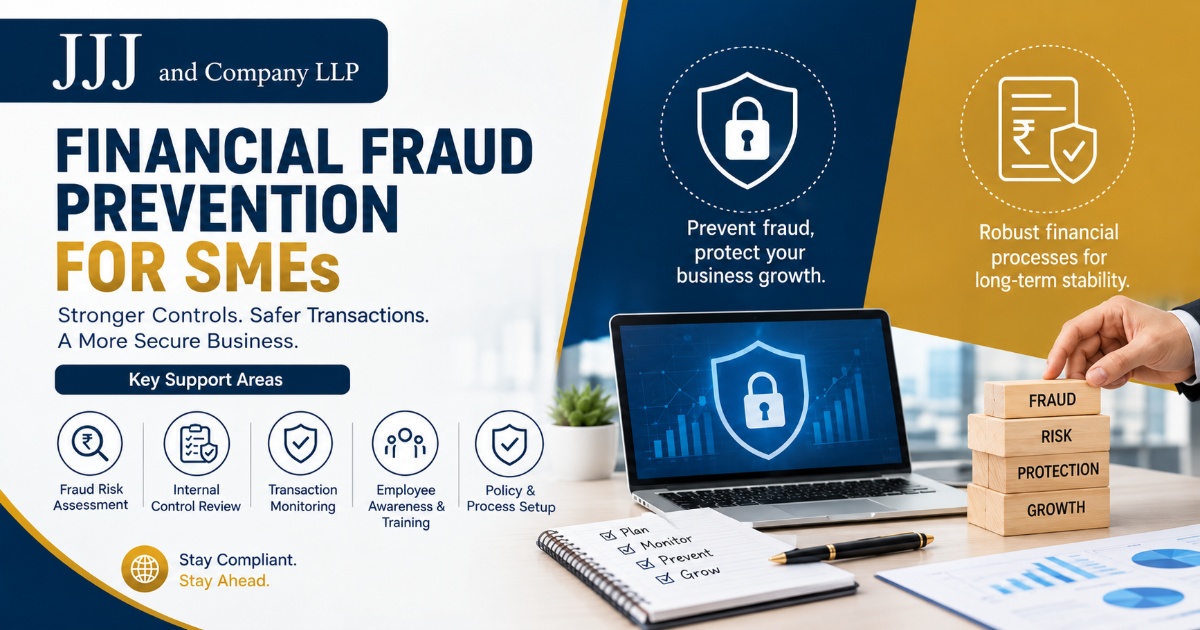
Financial fraud prevention for SMEs starts with strong accounting controls. Small and medium-sized businesses can face serious financial risks from fake invoices, unauthorized payments, payroll fraud, vendor fraud, expense manipulation, cash theft and accounting irregularities. Without proper internal financial controls, even a trusted employee or long-standing vendor can create losses that may remain unnoticed for months.
For SME owners, preventing financial fraud is not only about conducting an annual audit. It requires segregation of duties, payment approval controls, bank reconciliation, vendor verification, accounting software access controls, expense monitoring and regular financial reviews.
If your business is searching for ways to prevent accounting fraud, detect financial irregularities and strengthen internal controls, this guide explains the most important accounting controls every SME should consider.
JJJ & Company LLP helps businesses strengthen accounting processes, identify financial control weaknesses and improve financial risk management. If you are concerned about fraud exposure or weak accounting controls, professional review can help identify gaps before they become costly problems.
What Is Financial Fraud in a Business?
Financial fraud occurs when someone deliberately manipulates financial information, transactions or company assets for personal or third-party benefit.
Fraud can be committed by employees, management, vendors, customers or external parties.
Common examples include:
- Fake invoices
- Duplicate payments
- Unauthorized expenses
- Payroll manipulation
- Vendor fraud
- Cash theft
- Expense reimbursement fraud
- Fictitious employees
- Manipulation of accounting records
- Unauthorized bank transactions
- Inventory theft
- Misuse of company credit cards
- Revenue manipulation
For SMEs, the risk can be particularly serious because many businesses operate with small finance teams and highly trusted employees.
Why SMEs Are Vulnerable to Financial Fraud
Large companies often have separate departments for finance, internal audit, procurement and compliance.
An SME may have only a few people managing these functions.
In some businesses, one employee may:
Create a vendor → approve an invoice → process payment → record the transaction.
This concentration of responsibilities creates an opportunity for fraud.
Another common problem is excessive dependence on trust.
Business owners may assume that a long-term employee would never misuse company funds. While trust is valuable, internal controls should not depend entirely on personal relationships.
Good controls protect honest employees as well as the business.
10 Accounting Controls Every SME Should Have
1. Separate Financial Responsibilities
One of the most important controls is segregation of duties.
Where possible, different people should be responsible for:
- Creating vendors
- Approving purchases
- Processing payments
- Recording transactions
- Reconciling bank accounts
When one person controls the entire transaction cycle, fraudulent activity becomes harder to detect.
For smaller businesses where complete segregation is difficult, owners or senior management can perform independent reviews.
2. Implement a Strong Payment Approval Process
Businesses should establish clear approval limits.
For example:
- Small expenses → Department approval
- Medium payments → Finance manager approval
- Large payments → Senior management/director approval
Payments should not be approved simply because an invoice exists.
The reviewer should confirm:
- Supplier details
- Purchase order
- Goods or services received
- Invoice amount
- Bank details
- Applicable taxes
- Approval authority
A structured approval workflow can significantly reduce unauthorized payments.
3. Reconcile Bank Accounts Regularly
Bank reconciliation is one of the simplest and most effective accounting controls.
The accounting records should be compared with bank statements regularly to identify:
- Unrecognized transactions
- Duplicate payments
- Unauthorized withdrawals
- Incorrect entries
- Missing deposits
- Unusual transfers
Waiting until the end of the financial year to discover irregularities is risky.
Monthly reconciliation should be a minimum for most SMEs, while higher-risk businesses may benefit from more frequent reviews.
4. Control Vendor Creation and Changes
Vendor fraud can become expensive when fake suppliers or manipulated bank details enter the accounting system.
Businesses should have a documented vendor onboarding process.
Before creating a vendor, verify relevant information such as:
- Legal name
- PAN
- GST details where applicable
- Bank account
- Contact information
- Business address
- Supporting documentation
Changes to vendor bank details should receive additional verification.
A simple practice such as independent confirmation of bank-account changes can prevent certain payment frauds.
5. Use Purchase Orders and Three-Way Matching
Businesses can reduce procurement fraud by matching:
Purchase Order + Goods/Service Receipt + Supplier Invoice
This is commonly known as three-way matching.
For example, if a supplier submits an invoice for 500 units but only 350 units were actually received, the discrepancy should be identified before payment.
This control is particularly useful for SMEs dealing with inventory, manufacturing, wholesale or large procurement volumes.
6. Review Employee Expenses
Expense reimbursement fraud can happen when employees submit:
- Duplicate bills
- Personal expenses
- Inflated claims
- Fake receipts
- Expenses outside company policy
Businesses should define clear expense policies covering:
- Eligible expenses
- Approval limits
- Supporting documents
- Travel allowances
- Corporate card usage
- Submission deadlines
Expense reports should be reviewed independently rather than automatically approved.
7. Restrict Access to Accounting Software
Accounting systems contain sensitive financial information.
Employees should receive access based on their job responsibilities.
For example, an employee responsible for invoice entry may not need permission to:
- Delete transactions
- Modify vendor bank details
- Approve payments
- Change financial records
- Access payroll information
Businesses should also review user access whenever an employee changes roles or leaves the organization.
8. Monitor Unusual Transactions
Fraud often leaves behind unusual patterns.
Management should periodically review transactions for:
- Repeated round-number payments
- Weekend or unusual-time transactions
- Duplicate invoices
- Sudden vendor price increases
- Payments just below approval limits
- Unusual employee reimbursements
- Rapid changes in vendor bank details
- Unexplained cash withdrawals
Technology can help identify unusual transactions, but human review remains important.
9. Conduct Periodic Internal Reviews
An SME does not necessarily need a large internal audit department to perform meaningful financial reviews.
Periodic reviews can examine:
- Revenue
- Expenses
- Vendor payments
- Payroll
- Bank accounts
- Inventory
- Receivables
- Related-party transactions
- Tax payments
- Major contracts
The objective is not simply to find fraud. It is to identify weak processes before they become serious problems.
10. Create a Fraud Reporting Mechanism
Employees may notice irregularities before management does.
A confidential reporting mechanism can allow employees to raise concerns about:
- Suspicious payments
- Vendor relationships
- Expense manipulation
- Conflicts of interest
- Theft
- Financial misconduct
Employees should know that genuine concerns can be reported without unnecessary fear of retaliation.
Common Financial Fraud Warning Signs
SME owners should pay attention when they notice unexplained changes such as:
Financial red flags
- Profit does not match cash flow
- Expenses suddenly increase
- Receivables remain unusually high
- Inventory repeatedly goes missing
- Certain vendors receive unusually high payments
Employee red flags
- One employee refuses to take leave
- Someone insists on controlling every financial task
- Unusual resistance to financial reviews
- Employees bypass normal approval procedures
Transaction red flags
- Duplicate invoices
- Repeated payments to similar bank accounts
- Frequent manual accounting adjustments
- Unusual round-number transactions
- Transactions without supporting documentation
A red flag does not automatically prove fraud. It indicates that the transaction deserves further examination.
Accounting Controls vs Financial Audit
Accounting controls and audits serve different purposes.
Accounting controls are ongoing processes designed to prevent and detect errors and irregularities.
Financial audits provide an independent examination of financial statements according to the applicable auditing framework.
Businesses should not assume that an annual audit alone eliminates fraud risk.
Strong internal controls should operate throughout the year.
How Technology Can Help Prevent Fraud
Modern accounting software can improve financial controls through:
- User permissions
- Approval workflows
- Audit trails
- Automated reconciliation
- Duplicate invoice detection
- Transaction alerts
- Digital documentation
- Payment authorization controls
However, technology is only effective when configured correctly.
Giving every employee administrator access to accounting software can defeat the purpose of having a digital control system.
What Should SMEs Do If They Suspect Fraud?
If a business identifies a suspicious transaction, management should avoid immediately deleting records, confronting individuals without evidence or altering accounting data.
Instead, the business should consider:
- Preserving relevant financial records.
- Identifying the transactions involved.
- Restricting further unauthorized access where appropriate.
- Reviewing supporting documents.
- Examining related transactions.
- Obtaining professional advice.
- Assessing legal, tax and reporting implications.
- Strengthening the control that failed.
The appropriate response depends on the nature and seriousness of the suspected fraud.
How JJJ & Company LLP Can Help SMEs
Financial fraud prevention starts with understanding where a business is most exposed.
JJJ & Company LLP can assist businesses with accounting reviews, financial controls, risk identification, audit-related support and financial advisory requirements.
A professional review can help identify weaknesses such as:
- Poor segregation of duties
- Weak payment controls
- Vendor verification gaps
- Inadequate reconciliations
- Unauthorized system access
- Weak documentation
- Financial reporting inconsistencies
The goal is not simply to identify problems after money has been lost. It is to build processes that make financial misconduct more difficult to commit and easier to detect.
Frequently Asked Questions About Financial Fraud Prevention for SMEs
1. How can SMEs prevent financial fraud?
SMEs can reduce financial fraud risk by implementing strong accounting controls, separating financial responsibilities, requiring payment approvals, reconciling bank accounts, verifying vendors, restricting accounting-system access and conducting regular financial reviews.
2. What are the most common types of financial fraud in SMEs?
Common SME financial frauds include fake invoices, duplicate payments, expense reimbursement fraud, payroll fraud, vendor fraud, cash theft, unauthorized bank transfers, inventory theft and manipulation of accounting records.
3. What are accounting controls?
Accounting controls are policies and procedures designed to protect company assets, prevent financial errors and detect unauthorized or fraudulent transactions. Examples include approval workflows, bank reconciliation, segregation of duties and transaction reviews.
4. What is segregation of duties in accounting?
Segregation of duties means dividing financial responsibilities among different people so that one person does not control the entire transaction process. For example, the person creating a vendor should ideally not be the same person approving and processing its payment.
5. How can a business detect financial fraud?
Businesses can detect potential fraud by reviewing unusual transactions, reconciling bank accounts, checking duplicate invoices, monitoring vendor payments, reviewing employee expenses and examining unexpected changes in revenue, expenses or cash flow.
6. What are the warning signs of accounting fraud?
Warning signs can include unexplained expenses, missing documents, duplicate invoices, unusual bank transfers, sudden vendor changes, unexplained inventory shortages, frequent accounting adjustments and transactions just below approval limits.
7. How often should an SME review its financial controls?
Financial controls should be monitored continuously, while detailed reviews can be performed periodically based on the size, industry and risk level of the business. Bank reconciliations and key transaction checks should generally not be left until year-end.
8. Can accounting software prevent financial fraud?
Accounting software can reduce fraud risk through user permissions, approval workflows, audit trails, automated reconciliation and transaction monitoring. However, software alone cannot prevent fraud unless access rights and financial processes are properly configured.
9. What should an SME do if it suspects financial fraud?
The business should preserve relevant records, identify suspicious transactions, review supporting documents, restrict inappropriate access where necessary and seek professional advice. Financial records should not be altered or destroyed while an investigation is being considered.
10. How can JJJ & Company LLP help with SME financial controls?
JJJ & Company LLP can help SMEs review accounting processes, identify internal control weaknesses, assess financial risks and strengthen procedures for payment approvals, reconciliations, vendor management and financial reporting.
Final Thoughts
Financial fraud prevention should not be treated as something relevant only to large corporations.
For an SME, a single major fraudulent transaction can affect working capital, employee salaries, supplier relationships and business growth.
The strongest approach combines clear approval procedures, segregation of duties, regular reconciliations, vendor verification, accounting-system controls, transaction monitoring and independent financial reviews.
Most importantly, businesses should regularly ask a simple question:
“If someone wanted to misuse our financial system today, where would the weakest point be?”
Finding that weakness before a fraud occurs is far less expensive than discovering it afterward.
JJJ & Company LLP can help your business review accounting controls, identify financial risks and build stronger financial processes for sustainable growth.