
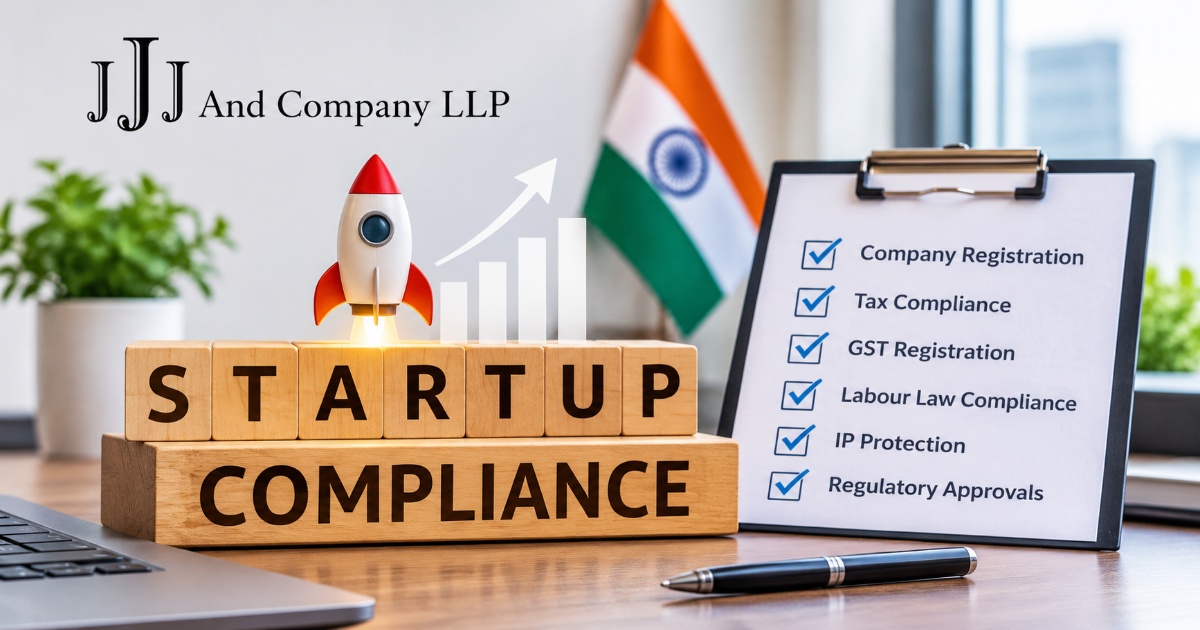
Launching a startup compliance in India is exciting, but the responsibilities of running a legally compliant business begin almost immediately after incorporation. Founders must manage customer acquisition, employees, funding, vendors and business operations while also meeting tax and regulatory obligations.
One common mistake is treating compliance as something to handle only when the business starts generating revenue. In reality, certain obligations begin with incorporation or registration, even when a startup has no customers, employees or taxable income.
For example, a private limited company may have annual MCA filing and statutory audit responsibilities even during a loss-making year. A startup making payments to consultants may need to examine TDS requirements, while a GST-registered business must follow applicable return-filing requirements.
Understanding these responsibilities early can help founders avoid penalties, tax notices and unnecessary complications during fundraising or business expansion.
This guide explains how startups can manage GST, TDS, income tax and MCA compliance through a practical approach.
The First 30 Days After Startup Incorporation: What Should Founders Do?
The first month after incorporation is an important period for setting up the business’s legal and financial systems. Instead of waiting for the first tax deadline, founders should establish a compliance process from the beginning.
Here are the important actions to consider:
Organise incorporation documents: Keep the Certificate of Incorporation, PAN, TAN, Memorandum of Association, Articles of Association and director details safely accessible.
Activate business banking: Open and operate a bank account in the company’s name and establish proper authorisation for business transactions.
Complete commencement formalities: Companies having share capital should examine the requirement to file the declaration of commencement of business in Form INC-20A within the prescribed 180-day period, subject to applicable law.
Evaluate GST registration: Review the nature of supplies, expected turnover, state of operation and compulsory registration provisions.
Set up accounting software: Create separate ledgers for sales, purchases, salaries, professional fees, loans, investments and other transactions.
Create a compliance calendar: Record GST, TDS, income tax, MCA and other applicable filing deadlines.
Review additional registrations: Check whether Udyam, Shops and Establishments, EPF, ESIC, professional tax or industry-specific licences apply.
The objective is simple: establish the compliance system before transactions become difficult to track.
GST Compliance: Why Startups Must Monitor Every Invoice
GST compliance is not limited to obtaining a registration certificate. It affects how a startup issues invoices, records expenses, collects tax and claims eligible Input Tax Credit.
When does a startup need GST registration?
The general registration thresholds commonly include:
- ₹20 lakh for services and businesses in many states.
- ₹40 lakh for eligible suppliers exclusively dealing in goods in states where the higher threshold applies.
Different limits apply in certain states, and compulsory registration provisions can require registration irrespective of turnover in specified situations.
For instance, an eligible startup providing consulting services may need to assess the ₹20 lakh threshold, while an eligible business exclusively supplying goods may qualify for the higher threshold. Inter-state supplies, e-commerce activities and other specific circumstances must also be examined under the applicable provisions.
Founders should not assume that every startup needs GST registration immediately or that remaining below the turnover threshold always removes the requirement.
Three GST areas founders should monitor
1. Correct invoicing: Ensure invoices contain the prescribed information, correct GSTIN details, applicable tax rates and proper classification.
2. Input Tax Credit reconciliation: Match purchase invoices with available GSTR-2B information and verify whether the credit is eligible before claiming it.
3. Return filing and tax payment: Registered startups under the regular scheme generally need to review applicable GSTR-1 and GSTR-3B filing obligations. Annual return requirements should also be evaluated.
A practical example
Suppose a technology startup purchases laptops, software subscriptions and professional services. GST may be charged on these purchases. However, the startup should not automatically treat every GST amount as eligible ITC.
The nature of the expense, business use, statutory restrictions, invoice requirements and other ITC conditions must be examined.
Expert recommendation: Reconcile sales, purchases, GSTR-1, GSTR-3B and GSTR-2B regularly. Waiting until the end of the financial year to identify GST mismatches can make corrections more difficult.
TDS Compliance: What Happens When a Startup Pays Freelancers and Consultants?
Startups frequently outsource work to freelancers, consultants, agencies, contractors and professional service providers. These payments may attract Tax Deducted at Source depending on their nature, applicable thresholds and statutory conditions.
Common payment categories that should be reviewed include:
- Salary paid to employees.
- Professional and consultancy fees.
- Contractor and freelance payments.
- Office rent.
- Commission and brokerage.
- Other specified payments covered by TDS provisions.
A common mistake founders make
Imagine a startup hires a marketing consultant and pays monthly professional fees. The founder records the full amount as an expense but does not examine whether TDS applies.
If deduction is required, the startup may face interest, late filing consequences and other compliance exposure.
A better process is to review every new vendor or service agreement before the first payment.
TDS compliance checklist
- Obtain the vendor’s correct PAN and payment details.
- Identify the nature of the payment.
- Check the applicable rate and threshold.
- Deduct tax at the appropriate time.
- Deposit TDS within the prescribed timeline.
- File applicable quarterly TDS statements.
- Issue certificates where required.
- Reconcile deductions with accounting and tax records.
Important 2026 income tax update
The Income-tax Act, 2025 came into force on 1 April 2026. TDS provisions have been reorganised, with provisions for salary withholding under Section 392 and other specified payments under Section 393.
For transactions governed by the new Act, startups should use the applicable new provisions and section references. Earlier transactions continue to be governed by the relevant transitional rules. The Income Tax Department has also clarified that the timing of credit or payment, whichever occurs earlier, determines which Act applies to TDS obligations during the transition.
Founders should ensure that their accounting software, payroll systems and TDS processes use the correct provisions for each transaction.
Income Tax Compliance: What If Your Startup Has Losses or No Revenue?

A startup may spend its first year developing technology, hiring employees, building infrastructure or acquiring customers without generating substantial revenue.
However, low revenue or business losses do not automatically remove income tax compliance obligations.
The startup must examine its legal structure, applicable return-filing requirements, taxable income, losses and other statutory conditions.
Important income tax responsibilities
Income tax return filing: Companies and other entities must determine their applicable return forms and filing requirements. A company should not assume that a nil-revenue year removes its filing obligation.
Advance tax: Startups with an estimated tax liability meeting the applicable conditions may need to pay advance tax in instalments.
Business expense records: Maintain invoices and supporting documents for rent, salaries, software, marketing, professional fees and other business expenditure.
Depreciation: Record qualifying assets such as computers, machinery and office equipment correctly and examine applicable depreciation provisions.
Tax audit: Check whether the business or professional activity meets the conditions requiring a tax audit.
Loss management: Maintain accurate financial statements and tax records so that eligible business losses can be evaluated for carry-forward and set-off under applicable conditions.
Why startup losses require attention
Suppose a startup spends ₹30 lakh on product development, employee salaries and marketing but earns only ₹12 lakh during the year.
The financial statements may show a loss. However, founders should still ensure that expenses are properly documented, personal and business transactions are separated, and the tax return reflects the correct position.
The ability to carry forward and set off losses depends on the applicable tax provisions and compliance conditions. It should not be assumed that every accounting loss automatically becomes an eligible tax loss.
2026 update: The Income-tax Act, 2025 and Income-tax Rules, 2026 apply from 1 April 2026. Startups should use the relevant provisions and forms for the applicable tax year rather than relying entirely on older section references.
MCA Compliance: Annual Filings Even When a Startup Is Not Profitable
A private limited company registered with the Ministry of Corporate Affairs has ongoing responsibilities under the Companies Act, 2013.
These responsibilities do not disappear simply because the company has not started commercial operations or has reported a loss.
Important MCA filings and formalities
| Form or Requirement | Purpose |
| AOC-4 | Filing financial statements with the Registrar |
| MGT-7 / MGT-7A | Filing the applicable annual return |
| DIR-3 KYC | Director KYC compliance, where applicable |
| ADT-1 | Filing auditor appointment information, where applicable |
| INC-20A | Declaration of commencement of business, where applicable |
| PAS-3 | Return of allotment when applicable |
The applicable form depends on the company’s category and the event being reported.
Annual compliance responsibilities
A private limited company should plan for:
- Preparation of financial statements.
- Statutory audit under applicable company law requirements.
- Board meetings and maintenance of minutes.
- Annual general meeting, where applicable.
- Filing financial statements and annual returns.
- Maintenance of statutory registers and company records.
- Event-based filings for changes in directors, share capital, registered office or other reportable matters.
For a typical company, AOC-4 is generally due within 30 days of the AGM and the annual return within 60 days of the AGM, subject to applicable exceptions and extensions. The AGM itself has a separate statutory timeline.
Important distinction: An LLP follows a different compliance framework, including applicable Forms 8 and 11. Founders should not apply private limited company filing requirements to an LLP.
Startup Compliance Calendar: Monthly, Quarterly and Annual Planning
A compliance calendar helps founders identify obligations before deadlines approach.
| Frequency | Compliance Activity |
| Monthly | Review sales, purchases, expenses, bank transactions and applicable GST obligations |
| Monthly | Check TDS deduction and deposit requirements |
| Quarterly | Review applicable GST return and TDS statement deadlines |
| Quarterly | Evaluate advance tax instalments, where applicable |
| Half-yearly / Annual | Complete applicable board and company governance requirements |
| Annual | Income tax return, financial statements, statutory audit and MCA annual filings, as applicable |
| Event-based | Report changes in directors, registered office, share capital and other specified events |
The exact due dates depend on the taxpayer category, financial year, statutory provisions and government notifications.
A founder should maintain one central calendar rather than managing GST, TDS and MCA deadlines through separate reminders.
Seven Startup Compliance Mistakes That Can Affect Fundraising
Compliance problems can become particularly important when a startup approaches investors, applies for loans or prepares for acquisition.
Investors and financial institutions may examine the company’s legal records, tax filings, financial statements and ownership information.
Common mistakes include:
- Missing annual MCA filings: Outstanding filings can create additional fees and governance concerns.
- Incorrect shareholding records: Incomplete share allotment documentation may create difficulties during investment due diligence.
- Unreconciled GST records: Differences between invoices, returns and accounting books can raise questions about tax exposure.
- Unreported TDS defaults: Incorrect deductions or delayed deposits may result in interest and other consequences.
- Poor expense documentation: Unsupported expenses make financial statements and tax positions harder to verify.
- Unrecorded founder transactions: Loans, reimbursements and payments between founders and the company should be properly documented and classified.
- Ignoring event-based filings: Changes in directors, share capital and other corporate information may require timely reporting.
A startup should conduct a periodic compliance health check rather than waiting for investor due diligence to identify missing records.
Expert Recommendations: Building a Strong Compliance System
Startup compliance should be treated as part of business management, not merely a year-end accounting exercise.
The following practices can make compliance more organised:
Assign clear responsibility: Identify who manages GST, TDS, accounting, income tax and MCA filings. The founder should retain oversight even when these activities are outsourced.
Close accounts every month: Review bank statements, sales, expenses, vendor balances and tax ledgers regularly.
Maintain a document repository: Store incorporation documents, contracts, invoices, board minutes, tax returns and payment challans in an organised system.
Review transactions before payment: Check GST and TDS implications before entering significant vendor agreements or making payments.
Conduct quarterly compliance reviews: Identify missing returns, tax mismatches, outstanding payments and upcoming corporate filings.
Seek professional advice before major decisions: Fundraising, share allotment, ESOPs, foreign investment and business restructuring can involve additional legal and tax requirements.
A well-managed compliance system gives founders better financial visibility and helps create confidence among investors, lenders, customers and business partners.
How JJJ & Company LLP Supports Startup Compliance in India
Managing GST, TDS, income tax and MCA filings can become challenging as a startup expands its operations and workforce.
JJJ & Company LLP assists startups, entrepreneurs and growing businesses with professional accounting, taxation and regulatory compliance services.
Support can include:
- Private Limited Company and LLP registration.
- GST registration and return filing.
- GST reconciliation and Input Tax Credit review.
- TDS deduction, payment and return filing.
- Income tax return filing and tax planning.
- Accounting and bookkeeping.
- Tax audit and statutory audit coordination.
- MCA annual and event-based filing assistance.
- Startup compliance reviews and business advisory.
A structured compliance approach can help founders reduce avoidable errors, maintain reliable financial records and concentrate on business growth.
Frequently Asked Questions
1. Is GST registration compulsory for every startup in India?
No. GST registration depends on turnover, the nature of supplies, location and compulsory registration provisions. Startups should evaluate their specific activities before applying.
2. Does a startup need to file an income tax return if it has no revenue?
A company may still have an income tax return filing obligation even if it has no revenue or reports a loss. The applicable requirements should be checked based on its legal structure and circumstances.
3. Is MCA annual filing compulsory for an inactive private limited company?
An inactive or non-operational company generally continues to have statutory filing obligations unless it has obtained an applicable legal status or exemption. It should not simply stop filing because there is no business activity.
4. When should a startup deduct TDS?
TDS should be examined whenever the startup makes payments or credits amounts covered by the applicable withholding provisions. The nature of the payment, threshold and relevant timing determine the obligation.
5. What are the important annual filings for a private limited company?
Common annual filings include AOC-4 and MGT-7 or MGT-7A, as applicable. Companies must also consider statutory audit, AGM and other corporate governance requirements.
6. What is the difference between MCA compliance for an LLP and a private limited company?
Private limited companies follow the Companies Act, 2013 filing framework, while LLPs follow the Limited Liability Partnership Act, 2008 and applicable rules. Their annual forms and filing responsibilities differ.
7. How can a startup avoid compliance penalties?
Maintain a compliance calendar, reconcile accounts regularly, track filing deadlines, preserve supporting documents and obtain professional assistance for transactions that have tax or regulatory implications.
Conclusion
Startup compliance in India involves more than filing tax returns once a year. GST, TDS, income tax and MCA requirements are connected to everyday business activities, including issuing invoices, paying employees, hiring consultants, recording expenses and changing company ownership.
Founders who establish proper accounting systems and compliance processes early can reduce avoidable errors and prepare their businesses for sustainable growth.
Whether you are setting up a new startup or reviewing the compliance position of an existing company, professional guidance can help you understand your obligations and maintain accurate records.
Need professional assistance with startup compliance in India?