
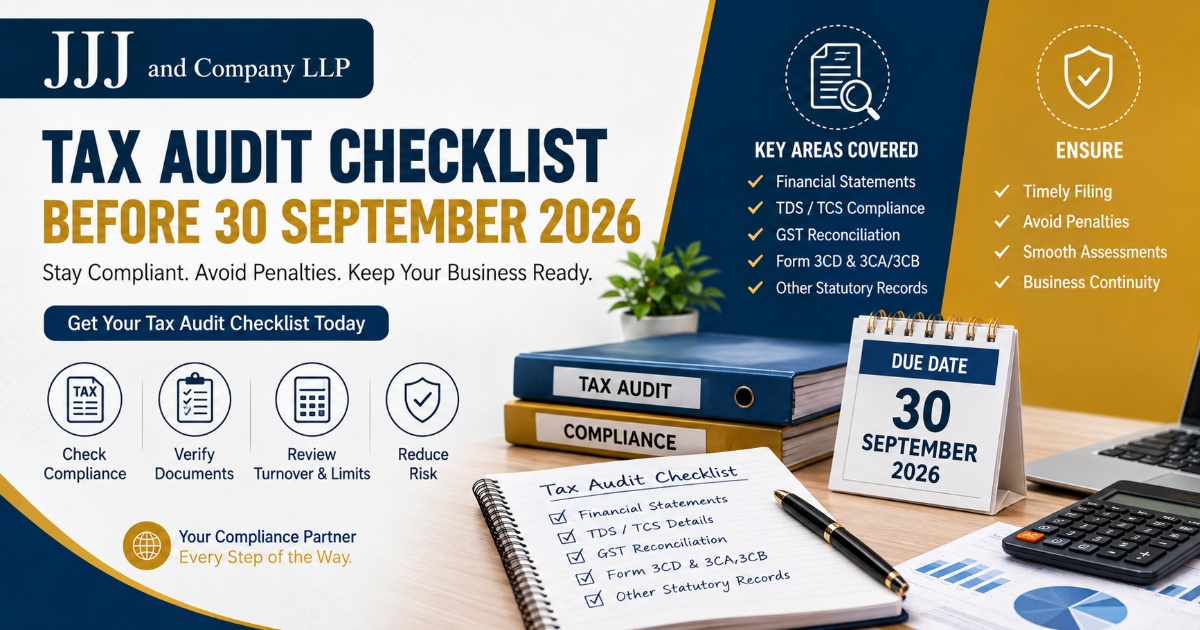
The 30 September 2026 tax audit deadline is one of the most important compliance dates for businesses, LLPs, companies, professionals, exporters, startups, and MSMEs in India. Every year, thousands of taxpayers wait until the last few days to complete their audit, reconcile accounts, and submit Form 3CD. This often leads to filing errors, delayed documentation, portal congestion, and unnecessary compliance pressure.
If your business is covered under Section 44AB of the Income Tax Act, this is the week to complete your tax audit. Waiting for the final day or hoping for a deadline extension can create avoidable complications for both your tax audit report and Income Tax Return filing.
This guide explains the latest tax audit due date extension update, provides a complete tax audit checklist, and highlights the documents and reconciliations every business should complete before 30 September 2026.
Complete your tax audit before the deadline with JJJ and Company LLP. Our team assists businesses with tax audit reports, Form 3CD, GST reconciliation, TDS verification, and Income Tax compliance across India.
Latest Tax Audit Due Date Extension Update (September 2026)
As the 30 September 2026 deadline approaches, several Chartered Accountant associations and trade organizations have requested CBDT to extend the due date for filing tax audit reports for Assessment Year 2026–27 (Financial Year 2025–26). The requests mention compliance challenges, delayed utilities, and technical issues faced during the filing season. Recent reports confirm that extension requests have been submitted to CBDT.
However, as of now, CBDT has not issued any official notification extending the tax audit due date. The applicable due date for filing the tax audit report continues to remain 30 September 2026. Businesses should prepare and file their audit reports based on the current deadline instead of waiting for a possible extension.
Why You Should Not Wait for a Possible Tax Audit Extension
Many businesses delay their audit work expecting a last-minute notification from CBDT. While extension requests may be under consideration, there is no certainty that the due date will change.
Waiting until the final week can result in:
- Incomplete financial reconciliations.
- Pending GST adjustments.
- Missing TDS entries.
- Delay in obtaining Form 3CD from your Chartered Accountant.
- Difficulty filing the Income Tax Return on time.
Completing the audit before the deadline gives businesses sufficient time to review financial statements and correct reporting errors.
Who Needs a Tax Audit for AY 2026–27?
Tax audit applicability depends on turnover, receipts, and the provisions of the Income Tax Act.
Businesses commonly covered include:
- Private Limited Companies.
- Limited Liability Partnerships (LLPs).
- Partnership Firms.
- Proprietorship businesses crossing applicable limits.
- Professionals under specified audit provisions.
- Export-import businesses.
- Manufacturing companies.
- E-commerce sellers.
- Service providers meeting tax audit conditions.
If your business falls under Section 44AB or other applicable audit provisions, the audit report must be filed electronically before the due date.
Tax Audit Checklist Every Business Must Complete This Week
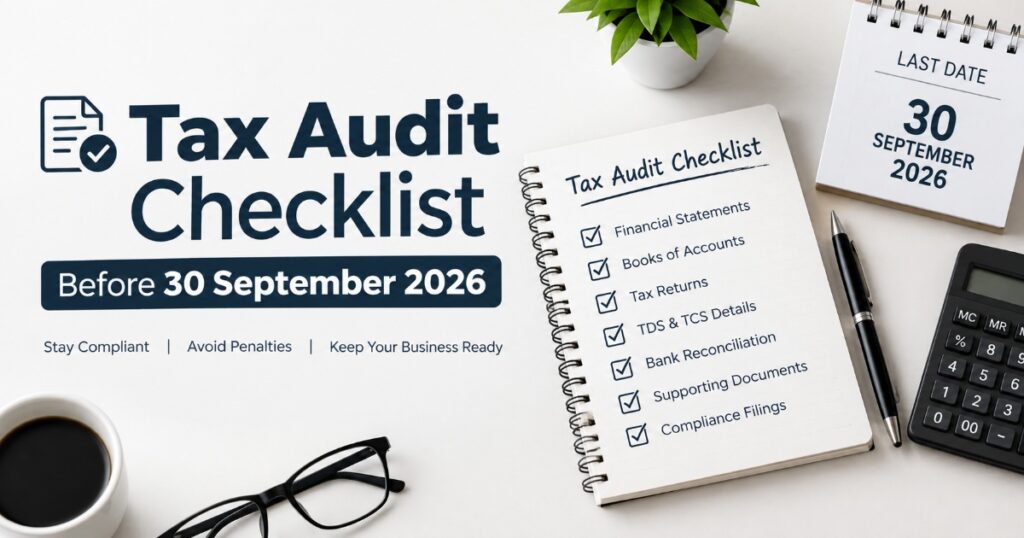
Below is a practical checklist to help businesses complete their tax audit smoothly before 30 September 2026.
1. Finalize Books of Accounts
The first step is ensuring your books are complete and accurate.
Review:
- Sales register.
- Purchase register.
- Expense ledger.
- Cash book.
- Bank book.
- Journal entries.
- Fixed asset register.
Any pending accounting entries should be completed before the audit begins.
2. Reconcile Bank Accounts
Bank reconciliation is one of the most important audit activities.
Verify:
- Closing balances.
- Pending deposits.
- Unpresented cheques.
- Interest entries.
- Bank charges.
Unreconciled transactions often create reporting mismatches.
3. Complete GST Reconciliation
Your GST returns should match your accounting records.
Reconcile:
- GSTR-1.
- GSTR-3B.
- Books of accounts.
- Output GST.
- Input Tax Credit.
- Credit notes and debit notes.
Differences should be identified and corrected before audit reporting.
JJJ and Company LLP assists businesses with GST reconciliation before tax audit filing to ensure consistency between GST returns and financial statements.
4. Verify TDS and TCS Records
Incorrect TDS reporting is a common reason for audit observations.
Check:
- TDS deducted.
- TDS deposited.
- TDS returns filed.
- Vendor PAN details.
- TCS collections where applicable.
Ensure Form 26AS and accounting records are aligned.
5. Review Outstanding Receivables and Payables
Prepare an updated ageing report.
Verify:
- Customer balances.
- Vendor balances.
- Advances received.
- Advances paid.
- Bad debts.
- Credit balances.
Proper reconciliation improves financial reporting accuracy.
6. Check Fixed Assets and Depreciation
Review your asset register carefully.
Include:
- New purchases.
- Asset disposals.
- Capital work in progress.
- Depreciation calculations.
- Asset classification.
Supporting invoices should be readily available.
7. Prepare Inventory Reconciliation
For trading and manufacturing businesses, inventory verification is essential.
Review:
- Opening stock.
- Purchases.
- Sales.
- Closing stock.
- Physical stock records.
- Inventory valuation method.
Inventory differences should be explained before audit completion.
8. Verify Loans and Borrowings
Businesses should reconcile:
- Bank loans.
- Director loans.
- Partner capital.
- Interest expenses.
- EMI schedules.
- Loan confirmations.
Loan balances should match lender statements.
9. Collect All Tax Audit Documents
Prepare a dedicated folder containing all audit documents.
Important Documents Include
| Document | Purpose |
| PAN and TAN | Income Tax compliance. |
| GST Registration Certificate | GST verification. |
| Financial Statements | Audit reporting. |
| Bank Statements | Reconciliation. |
| GST Returns | GST reconciliation. |
| TDS Returns | Tax verification. |
| Loan Statements | Liability verification. |
| Investment Details | Income verification. |
| Fixed Asset Register | Depreciation verification. |
Preparing documents in advance speeds up the audit process.
10. Review Cash Transactions
Businesses should verify compliance relating to cash receipts and payments wherever applicable.
Check:
- Large cash receipts.
- Cash payments.
- Cash withdrawals.
- Cash deposits.
- Supporting vouchers.
Maintain complete supporting documentation.
11. Verify Related Party Transactions
Companies and LLPs should identify related party transactions.
Review:
- Director payments.
- Partner remuneration.
- Loans to related parties.
- Purchases from related entities.
- Sales to related entities.
Proper disclosure is important during tax audit reporting.
12. Review Business Expenses
Ensure expenses are properly classified.
Common areas include:
- Professional fees.
- Rent.
- Salaries.
- Travel.
- Marketing expenses.
- Consultancy charges.
- Interest expenses.
Unsupported expenses may require clarification during audit.
13. Verify Foreign Transactions
Businesses involved in international trade or consultancy should review:
- Foreign remittances.
- Export income.
- Import payments.
- FEMA documentation.
- Form 15CA/15CB where applicable.
- Foreign exchange gains or losses.
Cross-border transactions should match bank records.
14. Review Advance Tax and Self-Assessment Tax
Check whether:
- Advance tax has been paid correctly.
- Interest calculations are accurate.
- Outstanding tax liability exists.
Resolving tax dues before filing reduces future notices.
15. Prepare Form 3CD Information
Form 3CD contains detailed tax audit disclosures.
Businesses should verify:
- Business information.
- Accounting method.
- Depreciation.
- GST details.
- TDS compliance.
- Related party disclosures.
- Deductions claimed.
Careful review reduces filing errors.
Need Form 3CD preparation and tax audit filing assistance? JJJ and Company LLP helps businesses prepare, review, and file tax audit reports accurately before the deadline.
Last-Minute Tax Audit Mistakes Businesses Should Avoid
Many businesses make avoidable mistakes during the final week before the deadline.
Common Errors Include
- Waiting for the last day to submit documents.
- GST turnover mismatch with books.
- Incorrect TDS reconciliation.
- Missing depreciation entries.
- Pending bank reconciliation.
- Incorrect PAN or GST details.
- Missing supporting invoices.
- Incomplete inventory records.
- Delayed approval of audit report on the Income Tax portal.
Avoiding these mistakes makes audit filing significantly smoother.
What Happens After the Tax Audit Report Is Filed?
Once the Chartered Accountant uploads the tax audit report:
- The taxpayer reviews the report.
- The report is approved on the Income Tax e-Filing portal.
- The audit report becomes available for Income Tax Return filing.
- The ITR for tax audit cases is filed before the applicable due date.
Businesses should not delay approval after the CA uploads the report.
Five-Day Action Plan Before 30 September 2026
| Day | Action Item |
| Day 1 | Complete books of accounts and bank reconciliation. |
| Day 2 | Finish GST and TDS reconciliation. |
| Day 3 | Share documents with your Chartered Accountant. |
| Day 4 | Review Form 3CD disclosures and financial statements. |
| Day 5 | Approve the tax audit report and prepare for ITR filing. |
Following a structured action plan helps businesses avoid last-minute compliance pressure.
Why Early Tax Audit Filing Is Better Than Waiting
Completing your audit before the deadline offers several advantages:
- More time to correct accounting errors.
- Faster GST reconciliation.
- Timely TDS verification.
- Smooth Income Tax Return filing.
- Reduced portal congestion.
- Better compliance documentation.
- Lower risk of missed deadlines.
Businesses that complete audits early are better prepared for subsequent tax filings and financial reporting.
How JJJ and Company LLP Helps Businesses Complete Tax Audit Before 30 September
JJJ and Company LLP provides comprehensive tax audit and Income Tax compliance services for businesses across India.
Our Tax Audit Services Include
- Tax Audit under Section 44AB.
- Form 3CA / 3CB / 3CD preparation.
- GST reconciliation before audit.
- TDS and Form 26AS verification.
- Financial statement review.
- Books of accounts finalization.
- Advance tax and tax computation.
- Income Tax Return filing for audit cases.
- Compliance support for Companies, LLPs, MSMEs, Startups, and Professionals.
Whether your business operates in manufacturing, trading, consulting, exports, logistics, healthcare, or technology, JJJ and Company LLP helps complete your tax audit accurately and before the statutory deadline.
Don’t wait until 30 September. Complete your tax audit this week with JJJ and Company LLP and avoid last-minute compliance issues.
Frequently Asked Questions (FAQs)
1. What is the tax audit due date for AY 2026–27?
As of now, the tax audit report due date is 30 September 2026.
2. Has the tax audit due date been extended?
Several professional bodies have requested CBDT to extend the deadline, but no official extension has been announced so far.
3. Should businesses wait for a possible tax audit extension?
Businesses should continue preparing and filing their tax audit before 30 September 2026 rather than relying on an extension.
4. What documents are required for a tax audit?
Books of accounts, financial statements, GST returns, TDS records, bank statements, fixed asset register, inventory records, loan statements, and supporting invoices are commonly required.
5. What is Form 3CD in a tax audit?
Form 3CD contains prescribed particulars and disclosures that form part of the tax audit report filed under the Income Tax Act.
6. Can GST reconciliation delay a tax audit?
Yes. Differences between GST returns and books of accounts should be identified and resolved before filing the tax audit report.
Conclusion
The 30 September 2026 tax audit deadline is approaching quickly, and businesses should treat this week as the ideal time to complete pending reconciliations, finalize books of accounts, verify GST and TDS records, and prepare Form 3CD. While there have been requests for a due date extension, there is currently no official CBDT notification extending the deadline, so timely preparation remains the safest approach.
If your tax audit is still pending, JJJ and Company LLP can help you complete the audit process, prepare the required reports, and ensure your business is ready for Income Tax Return filing before the statutory deadline.