

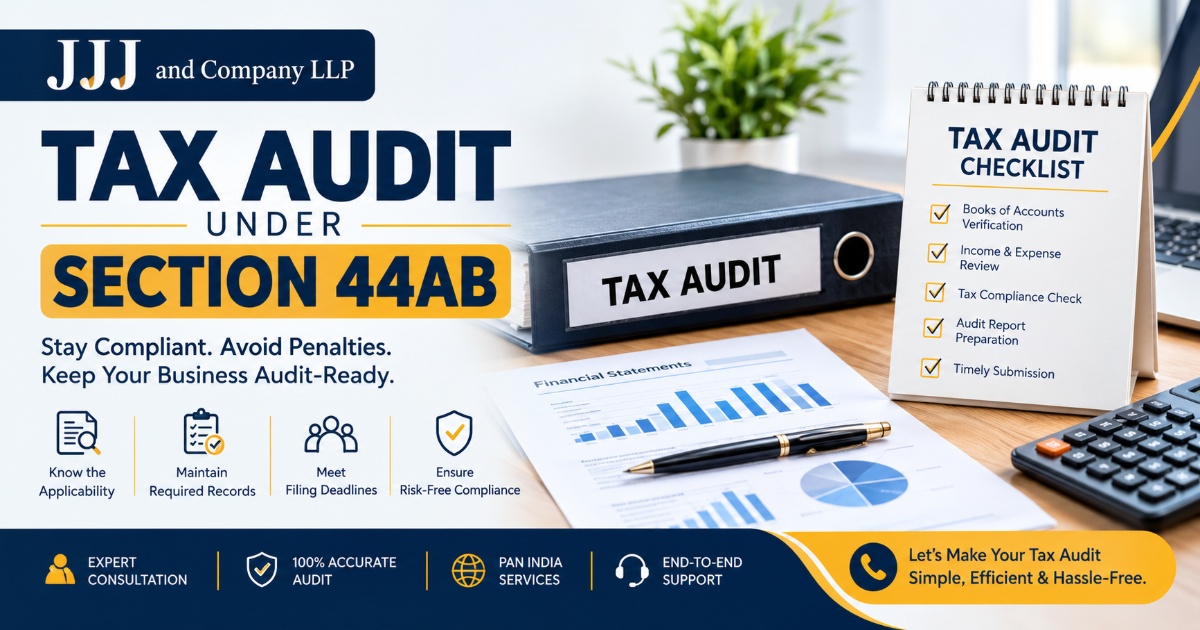
Is Your Business or Profession Liable for Tax Audit?
Tax audit is one of the most important compliance requirements for businesses and professionals in India. Under the existing Income Tax Act framework, Section 44AB requires specified taxpayers to get their accounts audited by a Chartered Accountant and furnish the prescribed tax-audit report.
For businesses, the commonly discussed threshold is ₹1 crore, but the limit can increase to ₹10 crore where the prescribed cash-receipt and cash-payment conditions are satisfied. For professionals, the gross-receipts threshold is generally ₹50 lakh.
However, turnover alone does not always determine tax-audit liability. Presumptive taxation, cash transactions, the nature of the profession and the income declared can also affect applicability.
Need Help With Your Tax Audit?
JJJ & Company LLP provides professional Tax Audit, Form 3CD, Income Tax Compliance and Tax Advisory Services for businesses, companies, LLPs, professionals and other eligible taxpayers.
Get your tax-audit applicability checked before the filing deadline.
What Is a Tax Audit Under Section 44AB?
A tax audit is an examination of specified financial and tax information by a Chartered Accountant for reporting prescribed particulars to the Income Tax Department.
The purpose is not simply to check whether the accounts add up.
A tax audit helps report relevant information concerning:
- Turnover and gross receipts
- Business and professional income
- Expenses and deductions
- Depreciation
- Loans and specified transactions
- Related-party payments
- TDS/TCS compliance
- GST-related information
- Accounting methods
- Tax deductions
- Certain payments and disallowances
- Other particulars required in Form 3CD
The Income Tax Department describes tax audit as a mechanism to ensure proper maintenance and correctness of books, report observations/discrepancies and furnish prescribed information under the Income Tax Act.
Tax Audit Turnover Limit Under Section 44AB
The basic threshold for a business is ₹1 crore.
However, the threshold can extend to ₹10 crore where cash receipts and cash payments remain within the prescribed 5% conditions. The Income Tax Department’s current guidance confirms this structure.
Quick Tax Audit Threshold Table
| Taxpayer / Situation | General Threshold / Condition |
| Business | Turnover/gross receipts exceeding ₹1 crore |
| Business with prescribed low-cash transactions | Threshold can extend to ₹10 crore |
| Profession | Gross receipts exceeding ₹50 lakh |
| Presumptive-taxation cases | Additional conditions may trigger audit |
| Certain taxpayers declaring income below prescribed presumptive levels | Audit may become applicable |
Important: The threshold is not the only test. The taxpayer’s method of taxation and other provisions must also be examined.
When Does the ₹10 Crore Limit Apply?
This is one of the most searched questions about tax audits.
For a business, the higher ₹10 crore threshold is available where:
Cash receipts do not exceed 5% of total receipts
AND
Cash payments do not exceed 5% of total payments
The Income Tax Department’s prescribed reporting information specifically asks about these cash/non-account-payee cheque or draft percentages and states that exceeding the relevant 5% condition can result in tax-audit liability.
Example
Suppose a business has:
- Total turnover: ₹6 crore
- Cash receipts: ₹10 lakh
- Total payments: ₹4 crore
- Cash payments: ₹12 lakh
The cash percentages need to be evaluated against the statutory conditions before concluding whether the ₹10 crore threshold can be used.
Therefore, businesses should not simply assume that turnover below ₹10 crore means no tax audit.
Tax Audit for Professionals
Professionals have a separate threshold.
Where gross professional receipts exceed ₹50 lakh, tax audit can become applicable under Section 44AB, subject to the applicable provisions.
Examples of professions can include:
- Legal professionals
- Medical professionals
- Architects
- Engineers
- Accountants
- Technical consultants
- Interior decorators
- Certain notified professionals
Professionals should also examine whether presumptive taxation provisions apply to their particular profession and circumstances.
Tax Audit and Presumptive Taxation
This is another area where businesses frequently make mistakes.
Sections such as 44AD, 44ADA and 44AE provide presumptive taxation mechanisms for eligible taxpayers.
A taxpayer using presumptive taxation may have simplified compliance, but the audit requirement can change when the taxpayer:
- Does not follow the prescribed presumptive-income rules;
- Declares income below the prescribed percentage;
- Opts out of presumptive taxation in circumstances covered by the law; or
- Falls under another provision requiring audit.
For example, the Income Tax Department’s validation rules specifically recognize audit implications where income is declared below the applicable presumptive percentage.
This means tax-audit applicability should be determined after examining both turnover and the income declared.
Form 3CA, Form 3CB & Form 3CD: What’s the Difference?
A common confusion is whether every taxpayer files the same tax-audit form.
They do not.
| Form | When Used |
| Form 3CA + 3CD | Accounts are already required to be audited under another law |
| Form 3CB + 3CD | Accounts are not required to be audited under another law |
| Form 3CD | Statement of prescribed particulars accompanying the tax-audit report |
The Income Tax Department confirms that Form 3CA-3CD applies where the taxpayer’s accounts are required to be audited under another law, while Form 3CB-3CD applies where there is no such other-law audit requirement.
Form 3CD Checklist: What Does a Tax Auditor Examine?
Form 3CD contains extensive particulars.
The current Form 3CA-3CD user manual explains that Form 3CD contains Part A covering basic particulars and Part B covering clauses 9 to 44.
Key Form 3CD Areas
A practical checklist should cover:
1. Basic Information
- Name and address
- PAN
- Status of assessee
- Previous year
- Assessment year
- Relevant business/profession details
2. Accounting Information
- Books of accounts maintained
- Accounting method
- Changes in accounting method
- Method of valuation of stock
3. Turnover & Financial Information
- Turnover/gross receipts
- Gross profit
- Net profit
- Financial statements
- Quantitative details where applicable
4. Depreciation
Review of:
- Fixed assets
- Additions
- Disposals
- Depreciation
- Written-down value
- Applicable depreciation provisions
5. Disallowable Expenses
The auditor may examine expenses affected by provisions relating to:
- Income-tax
- TDS defaults
- Certain statutory payments
- Related-party payments
- Cash payments
- Employee-related payments
- Other specified disallowances
6. Loans & Deposits
Particular attention may be required for transactions involving:
- Loans
- Deposits
- Specified sums
- Repayments
- Cash transactions
7. TDS/TCS Compliance
The tax auditor may reconcile:
Books → TDS/TCS records → Returns → Form 26AS/AIS → Financial statements
Differences should be investigated before finalization.
8. GST & Indirect Tax Information
Businesses should maintain proper reconciliation between:
Sales in books ↔ GST returns ↔ Tax audit data ↔ Income-tax return
This can help identify turnover mismatches before filing.
Tax Audit Due Date for AY 2026-27
For FY 2025-26 / AY 2026-27, the Income Tax Department states that the tax-audit report is to be filed by 30 September 2026.
This is important because taxpayers should not wait until the final week to begin the audit.
Recommended Internal Timeline
| Stage | Recommended Action |
| Early audit preparation | Collect books and supporting documents |
| Reconciliation | GST, TDS, bank and ledger reconciliation |
| Audit review | CA verifies financial and tax information |
| Form 3CD preparation | Prepare clause-wise reporting |
| Management review | Resolve discrepancies |
| Final submission | CA uploads report |
| ITR filing | Complete return within applicable deadline |
New Change: What Happens Under the Income Tax Act, 2025?
There is an important transition for taxpayers.
For FY 2025-26 / AY 2026-27, the existing Income Tax Act, 1961 forms continue to apply for tax audit — including Form 3CA, Form 3CB and Form 3CD.
For Tax Year 2026-27, under the Income Tax Act, 2025, the Income Tax Department states that Form 26 will replace and merge the erstwhile tax-audit reporting forms.
Transition at a Glance
| Period | Tax Audit Reporting |
| FY 2025-26 / AY 2026-27 | Form 3CA/3CB + Form 3CD |
| Tax Year 2026-27 | Form 26 |
| AY 2026-27 tax-audit due date | 30 September 2026 |
| Tax Year 2026-27 audit due date | 30 September 2027 |
This transition makes it particularly important for businesses and professionals to identify the correct form based on the relevant tax year.
Common Tax Audit Mistakes Businesses Should Avoid
Mistake 1: Assuming ₹10 Crore Is the Normal Limit
The ₹10 crore threshold depends on the prescribed cash transaction conditions.
Mistake 2: Ignoring Presumptive Taxation
Turnover alone may not settle the audit question where presumptive-taxation provisions apply.
Mistake 3: Filing Form 3CD Without Reconciliation
Tax-audit reporting should be supported by properly reconciled books and records.
Mistake 4: Ignoring TDS Differences
TDS deductions, deposits and reporting should be reconciled before finalizing the audit.
Mistake 5: Leaving GST Reconciliation Until the End
Turnover reported in GST returns should be reviewed against books and tax records.
Mistake 6: Starting the Audit Too Late
Tax audit is not simply a form-filling exercise. Clause-wise verification can require significant documentation.
Documents Required for Tax Audit
A practical tax-audit file may include:
- Trial balance
- Profit & Loss Account
- Balance Sheet
- General ledger
- Cash book
- Bank statements
- Sales register
- Purchase register
- Expense ledgers
- Fixed asset register
- GST returns
- TDS returns
- TDS certificates
- Loan statements
- Investment details
- Related-party transaction details
- Previous year’s tax-audit report
- Income-tax computation
- Details of deductions claimed
- Details of statutory dues
- Supporting invoices and agreements
The exact documentation depends on the nature and complexity of the taxpayer.
Why Professional Tax Audit Support Matters
A tax audit should not be treated as a compliance formality.
An incorrect turnover figure, missed disallowance, unreconciled GST amount, incorrect TDS information or incomplete Form 3CD reporting can create avoidable tax and compliance issues.
A professional review can help identify discrepancies before the report is submitted.
Get Your Tax Audit Reviewed by JJJ & Company LLP
JJJ & Company LLP provides professional tax-audit and compliance support for businesses, professionals, companies and LLPs.
Our services can include:
- Tax Audit Under Section 44AB
- Form 3CA-3CD
- Form 3CB-3CD
- Form 3CD preparation
- Income-tax compliance
- GST reconciliation
- TDS reconciliation
- Tax computation
- Statutory audit coordination
- Corporate tax advisory
- Presumptive taxation advisory
Need to Know Whether You Are Liable for Tax Audit?
JJJ & Company LLP can help assess your turnover, cash transactions, presumptive-tax position and applicable reporting requirements before the filing deadline.
Frequently Asked Questions
What is the turnover limit for tax audit under Section 44AB?
For business, the general threshold is ₹1 crore, with a higher threshold of ₹10 crore where the prescribed cash receipt and payment conditions are satisfied. For professionals, the general gross-receipts threshold is ₹50 lakh.
Is tax audit mandatory below ₹10 crore turnover?
Not necessarily. The taxpayer must examine the cash transaction conditions and other provisions of Section 44AB. Presumptive-taxation provisions can also affect applicability.
What is Form 3CD?
Form 3CD is the statement of prescribed particulars that accompanies the applicable tax-audit report under the existing Income Tax Act, 1961 framework.
What is the difference between Form 3CA and 3CB?
Form 3CA applies where accounts are required to be audited under another law. Form 3CB applies where the taxpayer’s accounts are not required to be audited under another law. Both are accompanied by Form 3CD.
What is the tax-audit due date for AY 2026-27?
For FY 2025-26 / AY 2026-27, the Income Tax Department states that the tax-audit report is due on 30 September 2026.
Will Form 3CD continue under the new Income Tax Act?
For FY 2025-26 / AY 2026-27, the existing forms continue. For Tax Year 2026-27, the Income Tax Department states that Form 26 will merge the earlier tax-audit forms.
Final Takeaway
Tax audit under Section 44AB is about much more than crossing a turnover threshold.
Businesses and professionals need to consider:
Turnover + Cash Transactions + Presumptive Taxation + Books + TDS + GST + Form 3CD + Applicable Tax Provisions
For FY 2025-26, taxpayers should also prepare for the transition from the existing Form 3CA/3CB + Form 3CD system to the new Form 26 framework for Tax Year 2026-27.
If you are unsure whether your business or profession is liable for tax audit, do not wait until the deadline.
Plan Your Tax Audit With JJJ & Company LLP
Tax Audit | Form 3CD | Income Tax Compliance | GST Reconciliation | TDS Compliance | Tax Advisory
Contact JJJ & Company LLP for professional tax-audit and income-tax compliance support.
